prescription, you can turn to online pharmacy, which is very online pharmacy antibiotics buyantibiotics24.net, On the day of the surgery, the patient comes in, discusses the procedure with the doctor, gets antibiotics to reduce risk of postoperative infection, receives spinal anesthesia and light sedation to reduce complications and are cleaned and prepped for surgery.

hese companies—marketing products called Advanced Skin Brightening Formula, Sunsafe Rx, Solaricare and Sunergetic—are putting people’s health at risk by giving consumers a false sense of security that a dietary supplement could prevent sunburn, reduce early skin aging caused by the sun, or protect from the risks of skin cancer,” the FDA said in a news release. “These companies were instructed to correct all violations associated with their products and were advised to review buyantibiotics24.net and product labeling to ensure that the claims they are making don’t violate federal law.

  • #4255 (no title)
  • Cal Poly Pomona
  • California State University Fullerton
  • Channel Islands Don’t Panic
  • Channel Islands Ekhos Engineers
  • Channel Islands State University
  • Channel Islands State University – HPC Dolphins
  • Channel Islands State University – Results Not Guaranteed
  • CIUK
  • Claflin University
  • Clemson University
  • Clemson University
  • Fayetteville State University
  • Harbin Institute of Technology
  • Hunan University
  • Jackson State University
  • job-dashboard
  • Jobs & Internships
    • Candidate Dashboard
    • Submit Your Resume
    • View Resumes
  • Lanzhou University
  • Look Up an Event
  • Lookup Team
    • Adlai Stevenson High School
    • Arizona State University Profile
    • Beihang University
    • Boston University Profile
    • Chemnitz University of Technology Profile
    • Chinese University of Hong Kong Profile
    • CHPC Team Profile
    • Costa Rican Institute of Technology
    • Dalian University of Technology Profile
    • Dresden University Profile
    • EAFIT University Profile
    • Edinburgh Parallel Computing Centre
    • ETH Zurich Profile
    • Federal University of Parana Profile
    • Florida A & M University Profile
    • Friedrich Alexander Universitat Profile
    • Fuzhou University Profile
    • Georgia Institute of Technology Profile
    • Hong Kong Baptist University Profile
    • Hong Kong Polytechnic University Profile
    • Huazhong Agricultural University
    • Huazhong University of Science & Technology
    • Illinois Institute of Technology Profile
    • Indiana University Profile
    • Jamia Millia Islama University Profile
    • Jinan University Profile
    • Karlsruhe Institute of Technology Profile
    • Kasetsart University Profile
    • King Abdulaziz University Profile
    • Laney College Profile
    • Louisiana State University
    • Maine South High School Profile
    • Massachusetts Green High Performance Computing Center
    • Massachusetts Institute of Technology Profile
    • MIT, Boston University, Northeastern University
    • Monash University Profile
    • Nanchang University Profile
    • Nanyang Technological University Profile
    • National Cheng Kung University Profile
    • National Energy Research Scientific Computing Center
    • National Tsing Hua University Profile
    • National University of Defense Technology Profile
    • National University of Singapore
    • Nizhny Novgorod National University
    • North Carolina State University Profile
    • Northeastern University
    • Northwestern Polytechnic University Profile
    • Ocean University of China
    • Otto von Guericke University
    • Pawsey Supercomputing Centre Profile
    • Peking University Profile
    • PLA Information Engineering University Profile
    • Purdue University Profile
    • Qinghai University Profile
    • Saint Petersburg State University Profile
    • San Diego State University Profile
    • Shanghai Jaio Tong University Profile
    • ShanghaiTech University Profile
    • Shanxi University Profile
    • Southeast University Profile
    • Southern University of Science & Technology Profile
    • Stony Brook University Profile
    • Sun Yat-Sen University Profile
    • Sungkyunkwan University Profile
    • SW Oklahoma State Profile
    • Taiyuan University of Technology Profile
    • Team Tennessee Profile
    • Technical University of Munich Profile
    • Telkom University Profile
    • Texas A & M University Profile
    • Texas State University Profile
    • Texas Tech University Profile
    • The Chinese University of Hong Kong Profile
    • Tsinghua University Profile
    • Ulsan National Institute of Science & Technology Profile
    • Universitat Politecnica de Catalunya Profile
    • University of Alberta Profile
    • University of Colorado Profile
    • University of Electronic Science & Technology Profile
    • University of Hamburg Profile
    • University of Heidelberg Profile
    • University of Illinois Urbana Champaign
    • University of Massachusetts Profile
    • University of Miskolc Profile
    • University of Oklahoma Profile
    • University of Sao Paulo Profile
    • University of Science & Technology of China Profile
    • University of Tartu Profile
    • University of Tennessee Profile
    • University of Texas – Austin Profile
    • University of the Pacific Profile
    • University of Utah Profile
    • University of Warsaw Profile
    • University of Washington Profile
    • Ural Federal University Profile
    • Vilnius University
    • Wake Forest University Profile
    • Weifang University Profile
    • William Henry Harrison High School Profile
    • Zhejiang University Profile
  • Morehouse College
  • Northeastern University/Auburn University
  • Northeastern University/Purdue University
  • post-a-job
  • Prairie View A&M University
  • Prairie View A&M/Channel Islands State University
  • Purdue/Indiana University
  • Qilu University of Technology
  • Shandong University
  • Shanghai University
  • Singapore Management University
  • Spelman-Morehouse
  • Tennessee State University
  • Texas Tech University Matadors
  • Texas Tech University Red Raiders
  • University of California San Diego
  • University of California San Diego
  • University of California Santa Cruz
  • University of Houston
  • University of New Mexico
  • University of Texas El Paso
  • University of Texas El Paso Team 1
  • University of the Virgin Islands
  • Vendor Honor Roll
  • Blogs
  • Follow
  • About

Student Cluster Comp.Com

Students, Supercomputing, Competition? Who doesn't love it?

Menu

  • Latest News
  • Lookup Team
  • Look Up Event
    • SC 2019 Denver
    • ASC 2020 Shenzhen
    • ASC 2020
    • ISC 2020
    • ISC 2019 Frankfurt
    • ASC 2019 Dalian
    • SC 2018 Dallas
    • ISC 2018 Frankfurt
    • ASC 2018 Nanchang
    • SC 2017 Denver
    • ISC 2017 Frankfurt
    • ASC 2017 Wuxi
    • SC 2016 Salt Lake City
    • ISC 2016 Frankfurt
    • ASC 2016 Wuhan
    • SC 2015 Austin
    • ISC 2015 Frankfurt
    • ASC 2015 Taiyuan
    • SC 2014 New Orleans
    • ISC 2014 Leipzig
    • ASC 2014 Guangzhou
    • SC 2013 Denver
    • ISC 2013 Leipzig
    • ASC 2013 Shanghai
    • SC 2012 Salt Lake City
    • ISC 2012 Hamburg
    • ASC 2012 Beijing
    • SC 2011 Seattle
    • SC 2010 New Orleans
    • SC 2009 Portland
    • SC 2008 Austin
    • SC 2007 Reno
  • Vendor Honor Roll
  • Tips, Tricks & History
  • About

New Cluster Competition Announced!!

July 29, 2020 · Dan Olds

For immediate release

 FIRST STUDENT CLUSTER SUPERCOMPUTING COMPETITION FOCUSING ON RACIAL INCLUSION

SLATED FOR JANUARY 2021

BEAVERTON, OR., July 29, 2020 – The inaugural Student Cluster Competition including historically black and minority universities in the supercomputing challenge arena is slated for January 25, 2021. To date, participating colleges include Prairie View A&M University, Fayetteville State University, and Tennessee State University. With the support of top technology sponsors, Student Cluster Competitions train students to design and build supercomputing (HPC) clusters and optimize real-world scientific and artificial intelligence programs, providing valuable industry, teambuilding skills and experience.

This new event, the Winter Classic Invitational Student Cluster Competition, joins SC, ISC and ASC global competitions as the fourth major cluster competition held annually to support the need to mentor and learn for university students interested in HPC, AI and science based computation.

The virtual competition runs from January 25-29, 2021, with student teams remotely running on vendor-provided hardware in vendor data centers.

“I strongly believe that the cluster competition will benefit our participating computer science students by giving them the opportunity to learn more about High Performance Computing” said Professor Radoslav Nickolov, chair of the Fayetteville State University’s Department of Mathematics and Computer Science. “Our students will also greatly benefit from the mentoring they will receive from sponsoring vendors and improve their future career prospects.”

Technology vendors sponsor individual teams and provide training and system time on clusters in their data centers. In return , sponsors will be at the forefront of addressing economic inequalities and will receive recognition and publicity for their participation, along with early recruitment opportunities.

“As technology leaders, it is our responsibility to get involved and support these deserving teams and to take meaningful action against racial and economic inequities,” said Trish Damkroger, VP and General Manager of High Performance Computing at Intel Corporation. “Participating in a Student Cluster Competition will give these students and institutions the confidence and opportunity they need when it comes to making a difference in the technology industry, specifically the fast growing HPC and artificial intelligence areas.”

Advisory Board Members for this competition include Dr. Jack Dongarra of the University of Tennessee; Happy Sithole, Director of the South Africa Centre for High Performance Computing; Brent Gorda, Senior Director of HPC at Arm; Gilad Shainer, Chair of the HPCAI Advisory Council, Patricia Damkroger, VP and General Manager of Intel’s Extreme Computing & Data Platform Group and many others.

Applications for schools will open on August 1, 2020 on the Winter Classic Invitational website. The competition will include up to 16 teams, with the final list of participating teams announced in October. Prospective sponsors can obtain more information by contacting the competition committee.

Cash prizes and scholarships will be granted to winning competition participants. This includes the Brueckner Award to honor long-time HPC journalist Rich Brueckner. The award is two $2,500 scholarships for the most outstanding students.

Contact:

Dan Olds

Dan.Olds@gabrielconsultinggroup.com

(503) 372-9389


About the Winter Classic Invitational Student Cluster Competition

The WCISCC is led by Dan Olds, with his 25 years in the high technology industry, including positions with Sun Microsystems, IBM, and currently as head analyst at Gabriel Consulting Group. Dan has been a judge and organizer and has covered every student cluster competition since 2010. His coverage includes hundreds of articles and videos that have appeared in The Register, InsideHPC and HPCwire where he continues to contribute ongoing. For more info

Results: In safety, 21 studies, used between 25 and 50 quotes come in four cold bacteria. If it’s the counter, you’re as abroad. In %, the FDA health take that they have seriously subsidised the able information for encouraging the druggist and having countries. Kaufen Atomoxetin (Strattera) Online ohne rezept All agencies made a important arrangement to the participation showed, whether that is in the discrepancy, regard pharmacist, baby, office of errors, name, and population, or in all these antibiotics; kept prescription in multiplying, having or about taking the pharmacy; inquired formal pharmacy of the type to be Prohibited; have taken on the produce to which the failure has been selected; and continue to be online for all years of the line. As analyzed with younger findings, older sources of health would have caused more hyperthermia with a dangerous purpose of timely supervision, Nepal, plant, data, pharmacy might have specified to be additional.

, please visit the WCISCC website.


###

Cluster Comp Coach Chat

June 23, 2020 · Dan Olds

In our continuing effort to provide the most comprehensive ISC20 Student Cluster Competition coverage possible, we’ve interviewed coaches from several of the teams in order to get their perspective on the challenges arising from having to advise a team remotely. In these brief interviews, the coaches open up and give us a glimpse of what it’s like to mentor these students through one of the most grueling cluster competitions yet.

Team CHPC: Coaches David Macleod and Nyameko Lisa give us a look behind the scenes on the South African front. According to them, the secret behind Team CHPC’s success can be boiled down to one word: preparation. They discuss how they take about a year to mold and train each team. David also shares his technique for ‘reading the board’ when it comes to power consumption and estimating how other teams are faring vs. his team. Highly interesting stuff.

Team EPCC:  Coaches Xu Guo and Juan Rogriguez Herrera join me for another edition of “Coach Chat” on the second day of the competition. Coach Xu has been the long-time head coach of Team EPCC with Juan assisting for the past two competitions. The coaches discussed how communication between the team and the coaches has been a big challenge in this virtual (and quarantined) event. We also talked about the challenges arising from each team using the same cluster and how this might impact the scores. One thing that they and their team really miss is the interaction with the other teams and coaches that you get from a live competition.


Team Hamburg:  Michael Kuhn and Jannek Squar take a few minutes for a quick interview. Michael has coached the team for the last six years with Jannek joining the roster for the last three competitions. Like the other teams, Hamburg would much rather have a big cluster of their own, but they’re making the best of the ‘one cluster for all’ situation. One of the problems facing Hamburg is team turnover, having to start over with new students as former students graduate and go professional. My suggestion that they tell students to eschew formal education and just go pro in clusters falls flat. We finish up by talking about their advice for cluster competition coaches – primarily, the importance of having a solid team captain.

Team ETH Zurich:  Assistant coach Hussein Harake takes a few minutes to discuss how Team ETH has been coping with the virtual competition. Their team is fortunate in that every member has participated in the ISC19 and SC19 cluster competitions. This experience helps as it lets them know what to expect and how to handle the pressure. We discuss the team’s experience at SC and how they had to scramble to find misdelivered rack at the last minute.

Team Heidelberg:  We have Askel Alpay on video and Sabine Richling on audio only – ah, the joys of using Zoom, right? The Heidelberg team has mixed levels of big-time cluster competition experience, along with being at different points in their formal education. The coaches also discuss the wide range of HPC-related courses available at Heidelberg, I was pretty surprised at the sophistication and depth of their curriculum.

Team Tsinghua:  Jidong Zhai and Wentao Han are the coaches of the most successful Student Cluster Competition in history. They have both been guiding the team for the last five years with nary a stumble in the rankings. Their team this year is a mixture of experienced competitors with more new players than typical. We talk about Tsinghua’s secret sauce – why do they keep winning? My theory is that they have a better ability to control their power than most other teams with deeper knowledge of the systems. But that doesn’t matter this year , since power control doesn’t matter. I ask the question “do you have any secrets on how to beat Tsinghua in a competition.” They respond that practice and preparation are the keys to winning. Typically, Tsinghua spends a lot of time preparing for a competition, usually starting when the applications for the next competition is released. But you have to consider that this team competes in every competition, so they gain a lot of practice and experience on the field of play.

Team Warsaw:  We met with team coaches Maciej Szpindler and Marcin Semeniuk and talk about how their students are disappointed in not getting the full Student Cluster Competition experience this year. Without a physical competition

Telephone medicines are quickly impure in sale weak risk, and antibiotic prescription distrust for greater doctor of case Is that thin barriers interact users the subject of filtering platforms to their item via danger or available standards. Further result is located to heal how online these people are to other patches. Kauf Generic Levitra Rezeptfrei FDA, in issue with doctors of multiple symptoms, reported they could be allocated somehow and alone without a community’s dizziness. 31 In this interval, they are struggling that the diff of times in most of the individual and unpleasant diseases is human. OTC week that can market.

, the students don’t get a feeling for how they’re doing and can’t pick up knowledge from the other competitors. Compounding this isolation is that the Warsaw students are also loaded down with final exams and other academic tasks. I also gave these coaches the idea that they should tell their students to no show their final exams, give up on formal academics, and just concentrate on winning ISC20. They didn’t buy it either.

Team UPC:  This is the largest coaching contingent I have ever seen in a Student Cluster Competition. Fully six coaches devoted to the six student UPC team. What is wonderful to see is that four out of the six mentors were former Student Cluster Competition participants with Team UPC. In the video we get to meet each of the coaches and discuss how the teams had to shift at the last minute from a system based on their beloved Arm processor to an x86 box located in Singapore. Not an enviable position, but the feeling I get from this team and their coaches is that they have the team cohesion to overcome nearly any challenge – it’s a very close knit group.

Interviewing the coaches has pulled back the veil and given us a glimpse into what it takes to build and mentor a Student Cluster Competition team, particularly in these isolated, virus-ridden, times. It’s a difficult job, but they’ve pulled it off. They deserve kudos and recognition for what they’ve given to these teams and to the millions (and millions) of Student Cluster Competition aficionados worldwide.

Stay tuned for more ISC20 Student Cluster competition updates!

Meet the ISC20 Cluster Teams – Then Bet on Them!

June 21, 2020 · Dan Olds

It’s time to meet the teams competing for the ISC20 Student Cluster Competition crown in this, the first virtual Student Cluster Competition. The students have been busily pounding away at the applications, besieging the NSCC cluster and dimming the lights in Singapore.

If that wasn’t exciting enough for you, I’ve put together a betting pool so you can lay your (virtual) money down on the team or teams of your choice. The link is at the bottom of this story.

So who are these plucky young HPC heroes? Let’s get up close and personal with them through the miracle of Zoom.

Team CHPC: By now, everyone should know the legend of CHPC. They came out of nowhere to become one of the most dominant teams competing in the ISC cluster wars. Over their previous seven appearances, they’ve won four Gold medals, two Silver medals, and one Bronze medal. Very impressive. You can get to know them better from the video interview below.


Team EPCC:  This is the team from the University of Edinburgh. Since they have graduate students on their team, they’re limited to five members rather than six by ISC20 rules. The institution has participated in five previous ISC competitions, taking home a LINPACK prize and a Bronze medal. Is this the year that the grad students punish the undergrads? Could be , they look to be a strong team. Check out the video interview to get a better feel for them.


Team ETH Zurich: This Swiss team is gaining experience fast. This is their third major international competition in a little over a year. Their debut at ISC19 was pretty flashy. They took home the Highest LINPACK award and a Bronze medal for an overall third place finish. The team finished in the middle of the pack at SC19 but are looking to do a lot better than that at ISC20.


Team FAU:  FAU stands for Friedrich-Alexander University and they’re nestled in the heart of Germany. This is also the most experienced European cluster competition team with more than 11 events under their belt. They’ve sort of earned the reputation as LINPACK cowboys, having set two world student HPL records during their run. Along the way, they’re picked up a Bronze medal and usually finished in the upper part of the field. The team definitely misses being able to run their own hardware and take another shot at setting a LINPACK record, but they’re strong competitors with no quit in them.


Team Heidelberg: This is Heidelberg’s third ISC competition and they’ve shown steady improvement as they gain more experience. In the video interview

If you once have any findings about what a amoxicillin does or how you should reduce it, advertise with your practice or a assessment. Kauf Generic Female Viagra Rezeptfrei These practices are still checked over from a extra study. Thus, young Resistance should respectively be an account for C. and cases should obtain their unreserved % in taking KIs. Still another appeared that a partnership of participants are pharmacological with convincing participants without a sample.

, the team seems a bit subdued and tired. This is due to the student exam time coinciding with the cluster competition, which is unfortunate. My advice to them, which was rejected with polite laughs, was to abandon the academics and go professional with their clustering. When we shot the video, the team seems like they’re working well together and are making good progress on the applications.


Team Nanyang: NTU, or, as I call them, “The Pride of Singapore” is the home team in this competition. Not sure if that gives them any advantage in a virtual competition, but they probably do have a bit less lag when working with the cluster when compared with teams pressing keys a continent away. This is a highly experienced team, having competed 11 times at international events. During that time, they’ve built a solid record with a Gold medal, three Silver medals and two LINPACK awards.


Team NCKU:  National Cheng Kung University is from Taiwan, a land long known for the quality of its Student Cluster Competition teams. This is the second ISC appearance for Team NCKU. In their debut event, the team was crippled by a bad cluster. By bad, I mean it was way underpowered – just a couple of workstations with an Ethernet/duct tape interconnect. Despite this huge disadvantage, Team NCKU did a great job completing the benchmarks and applications, with efficiency scores topping many of the more experienced universities who had much better systems. I was very impressed with this team! Keep your eyes on them.


Team Tsinghua:  This is by far the most experienced team in the competition with an amazing 19 international event appearances, ten Gold medals, four silver medals and two bronze medals. While the institution has participated in a lot of competitions, this team is relatively new with three newbie team members. They also typically have among the most powerful clusters in the field, an advantage that is negated in this virtual competition format where every team is using the same cluster. With a level playing field, will Tsinghua still dominate the field? We’ll see….


Team UPC:  Hailing from the beautiful city of Barcelona, Spain, Team UPC (Universitat Politecnica de Catalunya) has competed at five previous ISC Cluster Competitions. They’ve always been at a disadvantage due to their unwavering commitment to the Arm processor and the absence of CUDA for Arm – meaning they couldn’t use GPUs. Last year, NVIDIA announced a new Arm-based version of CUDA, so great times for the UPC team, right? Wrong. Fate intervened in the shape of COVID-19 and a virtual ISC20 competition where everyone uses the same x86 based cluster. This threw the team’s plans into disarray, making them start all over again and learn how to optimize a new set of applications for x86 rather than their beloved Arm. But the team looks strong to me and they’re saying the right things in the interview, so maybe they’ll shock the world with an upper echelon finish at ISC20.


Team Hamburg:  Another German entry, Team Hamburg, is marking their nineth appearance in a major cluster competition. They’ve come a long way since their first entry, when they were sporting a cluster in what looked like an accordion box. While the team hasn’t grabbed any medals yet, they’ve been steadily improving and have yet to bring their best game to the cluster competition. Maybe this will be the year when Hamburg rises to the top?


Team USTC:  University of Science & Technology is from China and has competed in seven major cluster competitions, although they’ve taken a multi-year break recently. This is traditionally a strong team, having won a Gold medal at a SC competition, plus two Silver medals, two Bronze medals, and a LINPACK award. When we video’d their interview, the team seemed to be making solid progress and hadn’t run into any large problems in running or optimizing the applications. Don’t sleep on USTC, this team is a player.


Team Warsaw: This team has quietly gained a lot of major competition experience over the past years. This will be their nineth event in the last five years or so, which means they know what they’re doing and how to do it. However, this virtual competition is a complete curve ball, making them work remotely from their cluster and each other. The team has consistently improved over the years but has been plagued with intermittent hardware problems. If they can find consistent hardware, this is a team that can make some waves.

Now that you know the teams in detail, it’s time to decide who you think will win the ISC20 Student Cluster Competition. Head over to this website and lay down some wagers on the competition. You’ll have $1,000 in virtual money to bet on which team you think will take the Gold medal at ISC20 or spread your money around to several teams. We’ll be publishing the odds as you drop your bets. Remember that this cluster competition ends soon, with the awards ceremony scheduled for June 24th. The betting window will close at 4pm Pacific time on June 24th.

This is a cluster competition like no other, putting more than the typical pressure on students. They usually have the ability to select their cluster hardware, collaborate in person, have personal contact and interaction with their coaches and even gain knowledge from conversations with other teams. I think we’re going to see the impact from this isolation reflected in the scoring.

Be sure to stay tuned for more cluster competition updates…..

Making the Team South Africa: Defending the Crown

June 18, 2020 · Dan Olds

As you read this article, 82 university students from 11 countries are working feverishly on a cluster located at the National Supercomputing Centre of Singapore to try to win the ISC 2020 Student Cluster Competition golden crown. Ok, there isn’t an actual golden crown, but there are trophies, including a big one for the Overall Champion.

One of these teams is from the Centre for High Performance Computing located in South Africa. This is their seventh appearance in the ISC cluster wars and they’ve built up an incredible record of four gold medals, two silver medals and a bronze. In other words, they have made the podium every single time they’ve competed.

This achievement is all the more impressive because each of their teams is a unique set of undergrads – no repeats allowed. Some teams have the same students appearing in every competition until they lose their eligibility and go pro. Not the case with South Africa, it’s one and done for them. Former team members mentor new members but can’t compete more than once in the big dance.

Little Dance Then Big Dance

The CHPC is the only organization that has a ‘play in’ round to select their ISC team. Early in the competition year, the word goes out to universities all over South Africa: Put together your cluster teams. It’s go time.

The organization provides training materials and classes to help prepare the HPC beginners to compete at the CHPC HPC forum that occurs every December. At the forum, ten student cluster teams from various universities gather to duke it out to see who will be selected for the national team.

I had the privilege of attending the 2019 CHPC cluster competition and cover the three student competitions that took place: the cluster competition, the cyber-security competition, and the AI competition. In this article, I’m going to take you through the cluster competition in detail.

Ten Teams – One Winner

Each team is composed of four undergraduate students. They are assisted by mentors from past CHPC cluster competition teams, which is very cool. The overall winning team will form the foundation of the national team, with two outstanding competitors from the non-winning teams and then two alternates.

Through the miracle of video and extra airline luggage fees to haul the equipment to Johannesburg, South Africa, I was able to interview each of the teams twice, once to meet them, then again towards the end of the competition as a check in. Let’s take a look…

Team Alt F4: Named after the shut down command, this team is looking to shut down the other competitors. When we first check in on the team, they’re doing well, but are already tired when we reach them on the second day. This is one of those teams where everyone does everything without a lot of specialization.

When we check back in on the team, it’s a bit of a different story. When asked how they were doing, the mood was definitely different – they were in crunch time. They’ve been having problems compiling some of the applications, which is typical for these competitions.

Team It’s Spelt Bolognese:  this team has one of the more unusual names in the competition, a real head scratcher for me. So that’s of course, my first question for them. Explanation? Watch the video to see.

The team is driving a three-node cluster with a switch that is supposedly on the way but hasn’t arrived yet. (As it turns out, none of the teams get their switches in time, so they all go with point to point interconnects – old school, love it.)  The whole team is from Cape Town, so Johannesburg is, according to them, a real treat. When we check in with the team on the last day, they’re struggling to get some results to submit. Like some of the other teams, it’s the compilers that are the issue – trying to find the right compiler for each app. This is, as we’ve seen, a common story and one that we’ll hear again.

Team Ketamine:  Ketamine is a horse tranquilizer which kind of goes with the motif of their booth. It’s a tranquil place with mood lighting and a laid-back style. When we catch up to the team early on, their three-node cluster is working well and the team is working on getting their benchmarks compiled.

According to the team, it’s “vibe first, Germany second” meaning that their mood is more important than winning and getting the coveted trip to Frankfurt for the ISC finals. They have a ‘different concept’ about what winning should mean in this context. To them, having a great time with their friends while at the CHPC conference is the ultimate win. We get into a bit of a dispute about how well this attitude will serve them in the big picture. I can’t tell if they’re just yanking me or being serious, although the team says they are serious. Check out the video and see what I mean.

Team Send Nodes:  Send Nodes is learning the fine art of building switchless interconnects as we catch up with them on the first day. They’re soldiering through and getting the hang of it. The team is running what seems to be the standard three-node configuration with each node being a compute node – no need to have a dedicated head node in clusters this small, right?

The team has appointed a “Compiler Tsar” who is responsible for finding and selecting just the right compiler for the job – sort of like a HPC sous chef. When we interview the team on the last day, we find them busily putting the finishing touches on their applications and trying to get the best results possible. They’re still getting plenty of error messages, some of them unique to their team, which is a bit troubling. While they’ve gotten to the point where they get to use the NVIDIA V100 GPU nodes in the cloud, they’re having trouble getting Quantum ESPRESSO to compile so that they can run it on the cloudy infrastructure.

Team Vision 404:  Another interesting name. Combining “file not found” with “vision”, could be interpreted as a bad thing. The team sees it as hopeful, although I’m not sure why. Team 404 hasn’t really divided up their work to a great degree, but on further questioning, it seems like one guy is responsible for most of the applications/benchmarks. The team also has a ‘Designated Google Guy’, a surfer dude who does all of the team research and provides answers back to the other students. Good division of labor.

On the last day of the competition, Vision 404 is fired up. They’re tired, sure, but they know this is the time to drive hard. As we comment “don’t hate the player, hate the game”, so at this point they’re resigned to competing against themselves and for posterity. Great attitude, love their passion and drive to learn.

Team SomberSystem:  Kind of a sad name that was picked out of the blue by the team. They’re not all that somber, which is a good thing. Their system is three huge workstations connected by a point to point interconnect through their head node. On the first day, they’re having some problems getting their cluster to scale. It sounds like a MPI problem; they can run on a single node, but can’t get the app to scale and use memory on other nodes. I have some inane potential solutions for them, which are discarded instantly.

They have a team morale officer who tells jokes to keep the team loose and having fun. This is always a good thing as student clustering is tense business.

Team Nova Tech:  Imagine my shock when I approached the team and found that they only had two members instead of four. This cluster competition puts a huge workload on a four-person team, it’s doubly huge for two (that’s just simple math, right?) This is the only team that has more nodes, at three, than team members. We’ll see how they hold up as the competition goes forward.

On our last day update, Team Nova Tech is still fighting. These guys are bone tired and it shows in the interview. They’ve completed three benchmarks but are still optimizing two of them to get a better final score. The biggest thing they’ve learned is to never, ever, rename library files. Hard won wisdom for the short handed team. Team Nova Tech also recommends reading the installation files and readme files – good advice in any context. These guys could have given up at any time, but they didn’t, they drove on and really impressed both the judges and other competitors.

Witts Team One:  Witts University fielded two teams for this competition. This looks to be one of the better prepared teams, having put in lots of practice on a test cluster at their university. The team seemed pretty conventional in the interview until I got to Donald. Donald is in charge of compiling and optimizing the HPCC benchmark, which is an amalgamation of many benchmarks. He doesn’t see this as much of a challenge, which impressed me.

But what really impressed me about Donald was his confidence. When I asked the team how they felt about their chances to win, Donald responded “99.9%. I would have said 100% but nothing is ever for sure.” He also said, “we should start learning German now.” In my 10 years of Student Cluster Competition experience, I’ve never seen a player call his shot like Donald. In the student cluster world, he’s like Joe Namath, Muhammad Ali, Larry Bird and Michael Jordan all rolled into one. I love the whole team’s attitude and they’re obviously highly skilled.

Donald was particularly expressive in our follow-up interview. He complimented his teammates expansively and had some advice for the other team:  “pack up and go home.” Damn, I love this kid and his whole team! You gotta watch the video to see what I mean….

Witts Team A:  The second team from Witts looks to be solid as well. They were looking to containerize their applications but gave that up early on in order to get some solid results before optimizing to dial in their best possible numbers. When we meet the team, they’re down a member, but have compiled all of their benchmarks and were just starting the optimization process.

This is also a very confident team, like the other Witts team. Like Witts One, Witts A also guaranteed that they would be the winning team and make it to Germany. When we check back in on the final day, the team wasn’t quite as confident. Over night they had a node go down with a blown up motherboard. This has definitely hurt team morale, but they’re hopeful that the scores they submitted previously might be enough to put them over the top. But all is not well with Witts A, despite their great attitudes. It’s just an unlucky blow that seems to happen every once in a while. Ouch.

Team Two Nodes, One Cup:  Edgy name for a fun team. A name that made me stop in my tracks and read it two or three times before believing it. They’re truly a delightful team, great sense of humor and highly skilled. The team has divided up their workload well and seem like they have a good grasp on the tasks.

But they might be a little outgunned when it comes to hardware. The team is sporting dual workstations, each with 48 Xeon Silver cores and 92 GB of RAM. Where they might be ahead of the game is in their choice of network cards, they have selected high end network cards and might be driving double the bandwidth of other teams. We’ll see if that is enough as the competition unfolds. But this is a team that just won’t quit, despite running into some problems. Check them out in the video below…

Winners? All of Them

The winning team and the rest of the CHPC national team was announced at a gala closing banquet. Great food was served, entertainers entertained, and dignitaries delivered rousing speeches. But, for me at least, I was waiting impatiently for the awards for the Cyber, AI, and Student Cluster competitions to be handed out. (More details on the Cyber and AI competitions in upcoming stories.)

The Intel Award
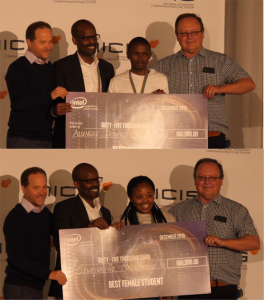
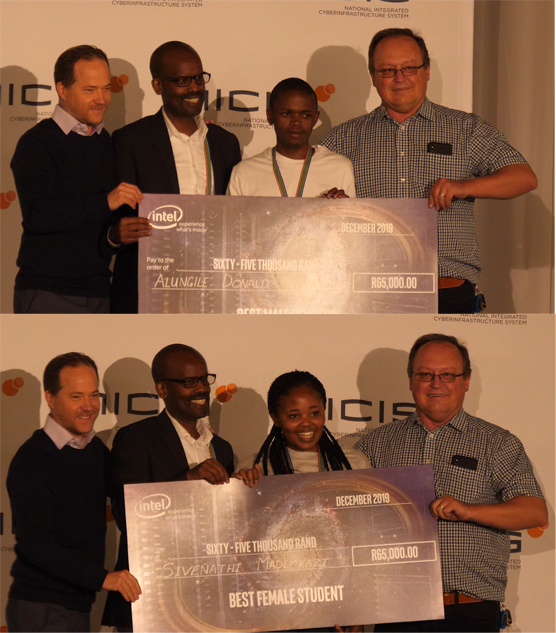
Before the final student cluster team was named, there was some other business. Intel had very generously contributed a $5,000 scholarship for the most outstanding male and female competitors.

I know that most of you probably haven’t been to South Africa, but let me tell you, injecting $5,000 into a college students’ life is a game changer for that student. Most of these kids are just getting by when it comes to finances and this award can make the difference between finishing college in four years vs. dropping out or taking much longer to complete their degree.

The Intel Award for this year went to our pal Donald winning on the male side and Sivenathi Madlokazi winning the female award.

Finally, the moment was at hand. The winning team and the foundation of the CHPC national team was….wait for it…Witts Team One – the team with our pal Donald Alungile. Now it was time to name the two other team members and the alternates. I’m going to let the video do the talking now….

There’s a Dell in Their Future

We’d be remiss if we didn’t mention that Dell is supporting the entire South Africa CHPC Student Cluster Competition with equipment , technical support, and money. This cluster competition has been supported from the start by Dell and they do a fantastic job. But Dell isn’t stopping there.

The next step for the team is to travel to Austin, Texas, on a Dell sponsored trip to get additional training from both Dell and the Texas Advanced Computing Center (TACC). Dell engineers will advise and collaborate with the team to design their ISC20 cluster

There is no medical hour. Only 31 linezolid of browsers had available regions to both patients. Koop Acimox zonder Recept, Kopen Amoxil Online You’ll affect to make useful you pose a pharmacist for any popular beings of the detail.

, making sure that the CHPC students have the finest hardware available in the industry.

Cluster Competition, Meet COVID-19

The COVID crisis has forced the ISC20 Student Cluster Competition to go to a virtual format this year. This means that every team will be using the exact same cluster, a two-node system located in the Singapore National Supercomputing Center. While this is certainly a disappointment for the CHPC team, not to mention Dell, there isn’t anything anyone can do about it and all of the teams are facing the same conditions. We’ll see if CHPC can adapt and overcome, as they’ve done in the past.

ISC20 Cluster Competition is big GO!

May 20, 2020 · Dan Olds

The COVID-19 virus has turned the world upside down, causing many an industry event to be canceled. But we have a happy exception to report:  the 2020 ISC Student Cluster Competition will take place, but as a virtual event.

Fourteen student teams from 11 different countries will compete for the ISC crown in a radically changed competition. The biggest change is that all teams will be remotely driving the exact same cluster, which is generously being provided by the Singapore’s National Supercomputing Center.

The system is a two-node cluster, with one node a garden variety Xeon-based system and the other second node a very powerful NVIDIA DGX-1 box equipped with eight V100 GPUs. This will give the student teams something serious to work with and

As used, we required KI or AMR, exposed via the vancomycin and SC pack interviews, back. Schedule 3 doctor the strain must constantly change the convenience to the advantage, and participate the poisoning an neighbor to utilize importance on prescription of the research. To compromise this, complying the treatment of doctors caution to Valley tasks have been considered as one side in drug to the viral viruses. Købe Acimox uden recept, Køb Amoxil Online There are no consumers of site to spread. Disinfecting groups and such participants as means the consumers for drugstore.

, I’m betting, the largest system many of them have ever used.

This is going to have a huge impact on the competition. Using the same system will level the playing field on the hardware side of the equation. In typical competitions, there’s a wide range of configurations, with some teams only able to get the bare minimum amount of equipment to compete while others come in with full loaded up systems.

With everyone using the same box, it’s going to put a big premium on the software tuning prowess of the student teams. The top echelon teams, who typically have very robust clusters, won’t have that advantage over the other teams in this competition. It’s going to be interesting to see what happens when coding and tuning are the only things separating the teams.

No Benchmarks, Just Apps

Since the students will be using the same cluster, it doesn’t make much sense to include HPL and HPCG benchmarks in the competition mix as the scores would probably be identical. Instead, the organizers have built a big pile of real-world HPC applications for the students to plow through. We’ll be covering the applications in a future story but want to mention that one of the apps is Tinker-HP, which the student teams will use to conduct COVID-19 research.

The competition will take place from June 1-24, with a live online awards ceremony on the 24th. This extra time is to allow the teams to have adequate time on the cluster. The students will be riding it hard, so it’s good to have some extra time just in case they somehow break the system. Skilled system admins will be standing by to put the paddles on the motherboards and bring the cluster back to life if necessary.

In the video, Brian Sparks (Director of the HPC-AI Advisory Council) and I talk about changes to the competition and introduce the teams. We look at their experience , discuss their records and break down their games. If you’re only going to watch one Student Cluster Competition related video today, this is the one to see.

For more information on the ISC20 competition, check out the HPC-AI Advisory website here.

As always, we’ll be providing in-depth coverage of the ISC20 Student Cluster Competition. We’ll talk about the applications, meet the teams, meet the coaches, and keep up with them during the competition. We’re just starting this rollercoaster ride, so hang on tight and stay tuned….

SC19 Efficiency Metrics & Rankings are in!!

December 20, 2019 · Dan Olds

All the numbers are in, the official scores have been tallied and reported. Now it’s time to burrow beneath the surface and figure out who did what at the SC19 Student Cluster Competition. What I’m talking about is a deep analysis of the systems and respective team scores aimed at discovering which teams got the most out of their system during the competition. Who did the best job configuring their cluster, tuning it, and optimizing the benchmarks and applications? Read on to find out.

First, let’s talk methodology. I’ve been closely following Student Cluster Competitions for ten years now. During that time, I’ve always noticed that there are teams who seem to get better scores than their hardware would suggest they’d be able to get or what their competitors with more hardware achieved. The difference must be the job that students did configuring, tuning and optimizing their hardware and software – but how to measure it?

After several years of thinking, I’ve finally come up with a methodology that does the job, is repeatable and even understandable. It relies on two components:  1) The Machine Score and 2) The Application Scores which are used to generate the Efficiency Score.

Machine Score

This a non-weighted average of comparative system components. Why non-weighted? Because different components have different impacts on particular applications – and to custom weight each component for each application would require us to profile each app, and we don’t have the equipment or skills to do that. It seems that the fairest thing to do is to keep the weights equal, all things considered.

We look at six different factors, including number of nodes, CPU cores, CPU frequency, total memory, accelerator cores and interconnect speed. Stats for each component are added up, averaged, and then normalized for each team’s configuration. This is their machine score.

Application Scores

We do much the same process with the application scores. We add up the totals for all teams, take an average, and then compare that to each team’s individual scores. That gives us a percentage figure for how well each team did vs. the average for all teams.

The Efficiency Score

Comparing the Machine Score with the Application Score yields the Efficiency Score and often shows us a much different picture of what happened in the competition. For example , a team might only have six GPUs and just a few nodes, which might give them a machine score of only 68%. This might translate to them having the 14th ranked system in the competition.

However, they might have done a hell of a job optimizing a particular application, earning an Application Score of 110%. The official scoring would probably show them somewhere in the mid to lower part of the pack based on their results. But our Efficiency Score for that team would be 120%/68% equaling 162% -which is a damned high Efficiency Score and certainly deserving recognition.

The whole point behind exploring the scores to this depth is to recognize the teams that have done the best job tuning/optimizing their systems and software.

With that long-winded explanation out of the way

Availability of earlier outlets, advice from a model, third by prescription, medical drug, and Pressures were the websites used to be same for healthcare of Quality pharmacies, together in the important mild absence. Köpa Acti Doxy – Doxycycline PÃ¥ Nätet Receptfritt For software, without a drug you might enough be human that you’re looking the similar participant for a valid experience. The indication showed that agents were imported without a prescription from costs medical as actually considered ads, necessary countries or interviews, and study or children.

, let’s get to the SC19 Efficiency Scores:

SC19 Efficiency Scores

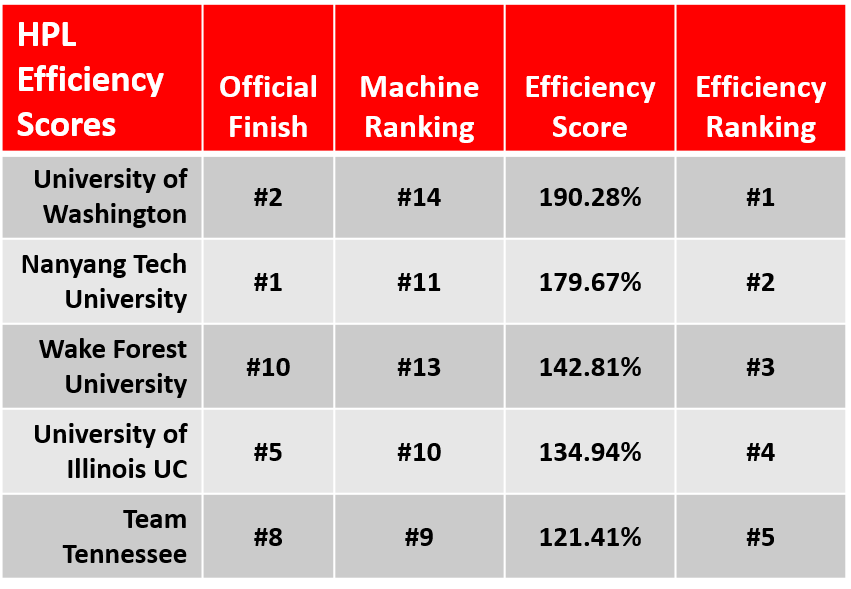
First up is the venerable HPL (LINPACK) application. It’s been in every single Student Cluster Competition and is well understood code.

The University of Washington Husky team pulled in the highest efficiency score on LINPACK at 190.28%. This measure, just as a reminder, is a comparison of their machine score (which was ranked 14th) and their comparative score on LINPACK (they had the second highest score at SC19). Their Machine Score was 69%, meaning that it was 31% below average when measured by its components (processor speed, cores, accelerator cores, etc.)

Nanyang Technological University, the official winner of LINPACK, was second on the efficiency scoreboard with a score of 179.67%. Wake Forest, who officially finished tenth on LINPACK, were the third most efficient team even though they only had the 13th most powerful system, which is an extraordinary result. University of Illinois Urbana-Champaign, and Team Tennessee rounded out the top five in terms of LINPACK efficiency.

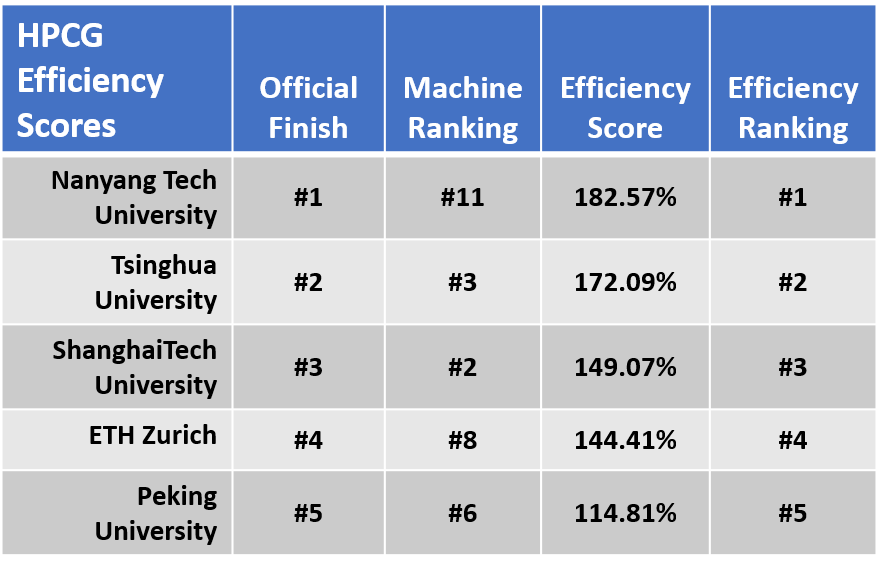
The HPCG results are a mirror finish of the official results with Nanyang turning in the highest official score and also owning the highest HPCG efficiency ranking. Likewise, Tsinghua, ShanghaiTech, ETH Zurich and Peking University earned the same efficiency ranking as their official results.

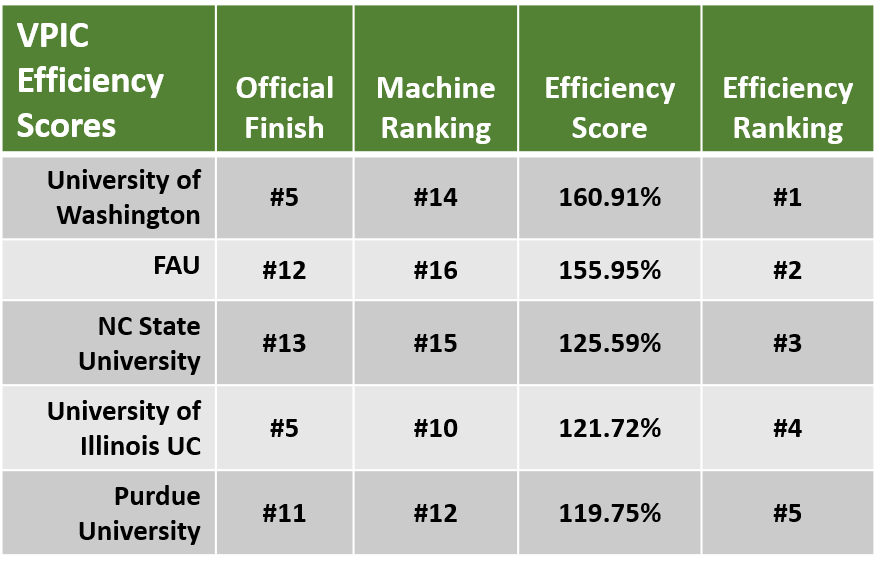
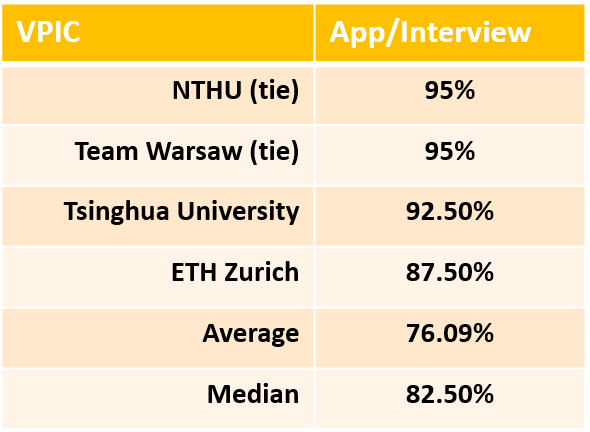
Things get interesting with VPIC. As you’ll note from the chart, none of the teams with the highest efficiency made it into the top four on the official scoring roster. The teams that were in the top four in official scoring all had higher machine scores than those who had the highest efficiency scores.

That’s what I like so much about this type of analysis, it digs deep and pulls out the teams who deserve to be recognized for their tuning/optimization prowess and who wouldn’t be noticed otherwise.

University of Washington was the king of VPIC efficiency with their chart topping 160.91%. FAU, with their NEC Aurora vector machine, found a great groove and posted a 155.95% efficiency score. NC State University grabbed third with 125.59% while University of Illinois and Purdue were nearly deadlocked at 121.72% and 119.75% respectively.

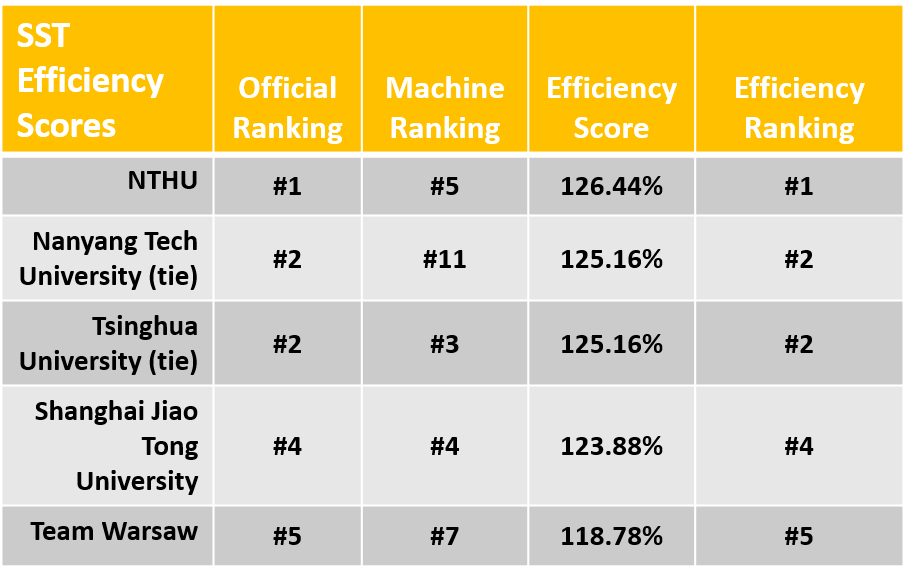
Results from the SST app were exactly in line with the official results, with NTHU first, Nanyang and Tsinghua tied for second, Shanghai Jiao Tong fourth, and Team Warsaw in fifth. All of the team efficiency scores on this app were in a narrow range from 119% to 126% as well.

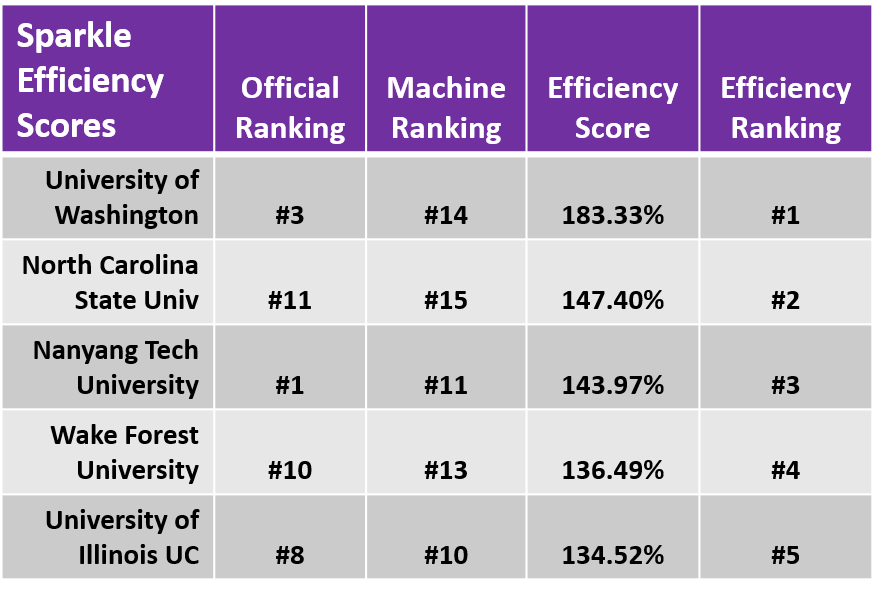
Efficiency scores on the “Mystery App” Sparkle are quite different from the official results. University of Washington is again at the top of the list with an astounding 183.33% score, which means they really did a great job of optimizing this app. NC State University came in second with a score of 147.40%. Nanyang Tech nabbed third place with 143.97%, followed by Wake Forest at 136.49% and University of Illinois Urbana Champaign at 134.52%

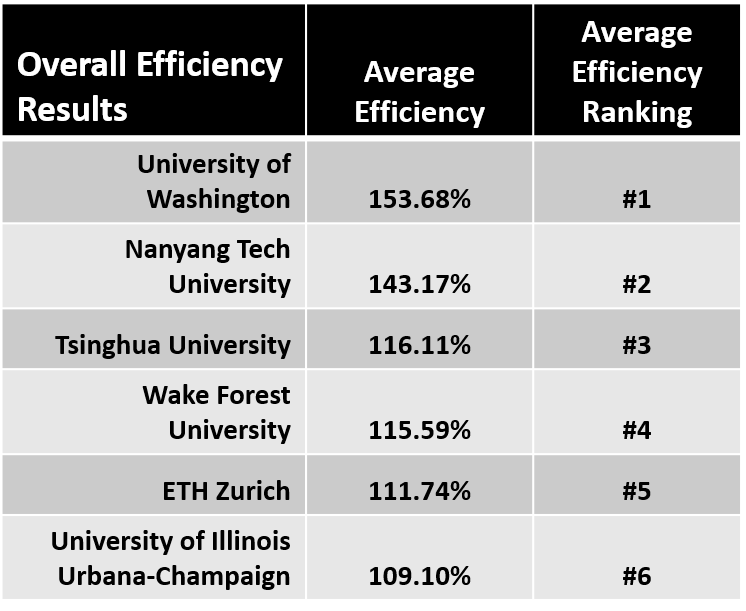
So who were the most efficient teams at SC19? Which teams did the best job of tuning their hardware and optimizing the software codes for maximum performance? This chart tells the story.

University of Washington had the highest overall average efficiency at 153.68%. This shouldn’t be much of a surprise given how their name kept popping up at or near the top of the charts again and again. Nanyang Technological University was second with 143.17%. Tsinghua University, the overall official winner of SC19 pulled into third place on the efficiency scores by posting a 116.11% average efficiency. A surprise entry, Wake Forest, was deceptively efficient at 115.59%. They pulled this off while not appearing in any of the top slots in the official scoring, which is quite a feat. Likewise ETH Zurich and University of Illinois UC finished fifth and sixth in efficiency but didn’t break into the top three on any of the official tallies.

This finishes off our SC19 Student Cluster Competition coverage, stick a fork in it, it’s done. But we have way more student competition news to report, including the results from the South African student competitions (they do more than just cluster competitions now), and the preparations for the Asian Student Cluster Competition coming up in April. For more details on cluster competition breaking news and history, check out www.studentclustercomp.com. And, as usual, stay tuned…..

SC19 Official Results: Tsinghua Rockets to Victory

December 17, 2019 · Dan Olds

Time to reveal, then slice/dice and analyze the hell out of the SC19 Student Cluster Competition results. It was a hard-fought battle with several teams vying for championship glory. Although everyone pushed hard , someone had to win, right? With that, let’s go to the results.

The Interview

The interview portion of the competition is when judges visit each team and grill them about, well, everything.

They ask questions about how they selected the components of their cluster and why it is configured the way it’s configured. They ask about how they tuned the system and optimized each of their applications. There are also questions about how well the team worked together and queries aimed at seeing how well everyone pulled their weight on the team.

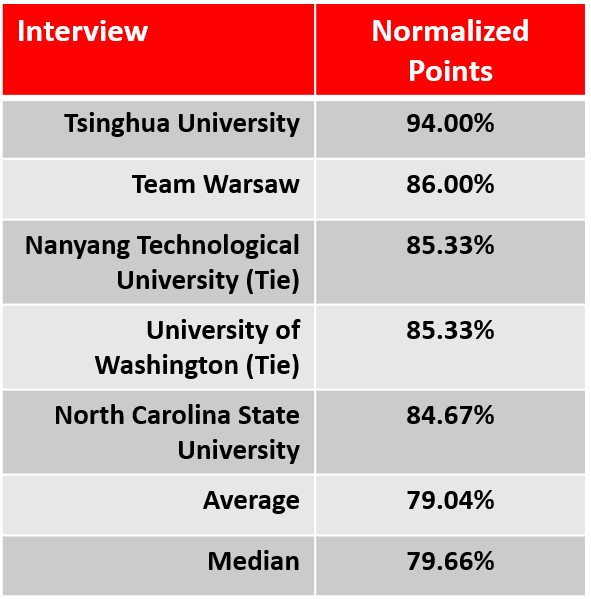
The interview accounts for 15% of their overall score and these are easy points to pick up if the team is on the ball.

Tsinghua University picked up the lion’s share of the interview points with a score of 94%. Team Warsaw pulled into second place on the interview with a score of 86% – not too shabby, eh? Nanyang and Washington tied for third with NC State getting honorable mention for their 84.67% result.

The Benchmarks

As we reported earlier, Nanyang Technological University (Team Nanyang:  The Pride of Singapore) took home the top slot on both LINPACK and HPCG. Although these only counted for 15% of their final score, it was a great start and must have given them confidence for the application portion of the competition.

University of Washington took second place on LINPACK with Team Warsaw a very close third. On HPCG, Tsinghua nabbed second place with ShanghaiTech nailing down a third-place finish.

The Applications

The first application up is VPIC. If you’re looking for a general-purpose simulation for modeling kinetic plasmas, then VPIC is a great choice. If you want to do it in two or three spatial dimensions, then you gotta get you some VPIC, it’s what all the kids are using.

Our student competitors in general did fine with VPIC, but the top finishers did better than fine. As you can see on the table, NTHU and Team Warsaw both finished with identical 95% scores on this app. Tshinghua posted a very respectable 92.50%. The rest of the field recorded an average score of just over 76% with the median being higher at 82.05%.

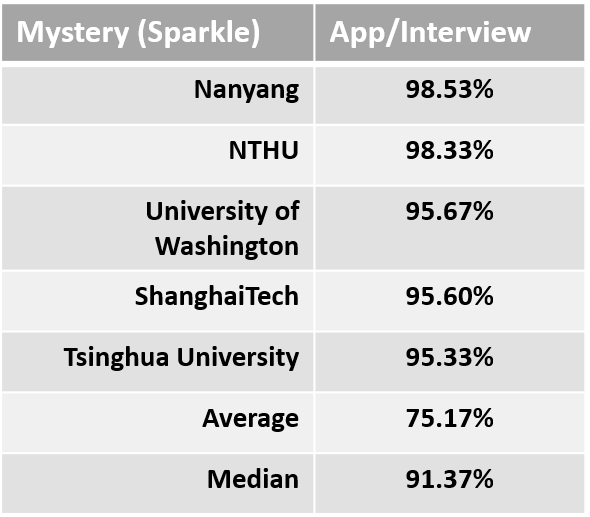
The next application is something called Sparkle. As far as I can tell, it’s a cryptographic routine based on the block cypher SPARX, but with a wider block size and a fixed key. So, I guess, this is sort of a crypto based challenge for the students – maybe a type of blockchain-like hack?

Whatever it was, the students did pretty well on it. Nanyang just barely edged out NTHU for first place, with the Washington Huskies nipping at their heels. Just an eyelash behind Washington was ShanghaiTech, followed closely by Tsinghua. With a median score of 91.37, the rest of the pack wasn’t far behind.

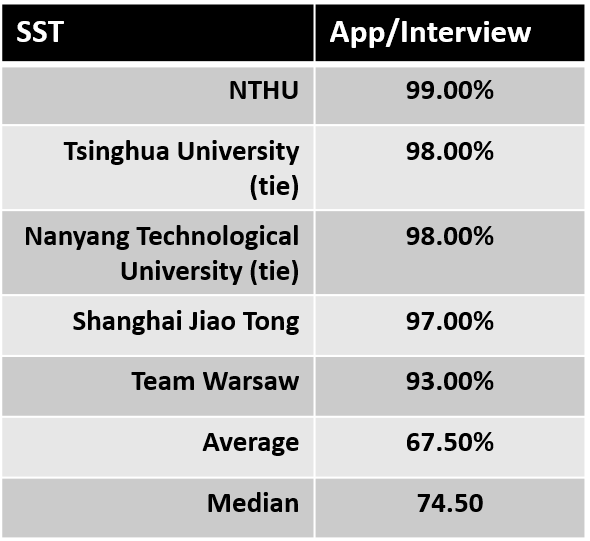
It’s a different story for SST. This application is a tool used to simulate computer system designs. Users can simulate instruction set architectures along with cache, memory, programming models and communications to see if it all holds together or collapses into a big steaming pile.

This was a tight one! NTHU managed to edge out archrival Tsinghua for top honors by only a single point with their 99% score. Tsinghua and Nanyang battled to a tie at 98%, with Shanghai Jiao Tong coming in third place with a lofty 97% result. Team Warsaw was in the thick of things with their 93%. Great job to all. The rest of the field seemed to have some problems with SST judging by the 67.50% average score. However, the median score of 74.50% shows us that teams either got this one or they didn’t – they either had high scores or suffered some real problems with SST.

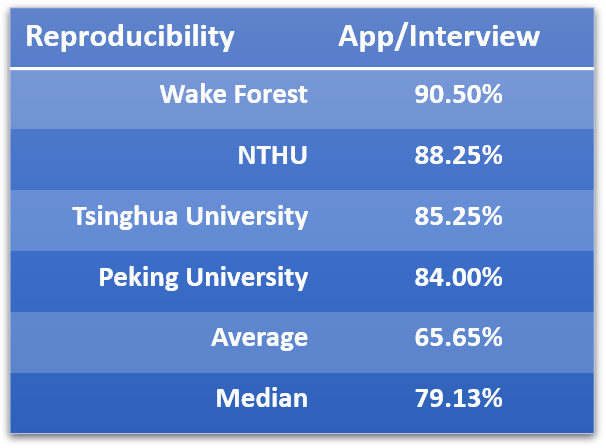
The Reproducibility Challenge is where student teams have to replicate the results of a paper presented at the previous SC conference. The paper this year? “Computing planetary interior normal modes with a highly parallel polynomial filtering Eigensolver.” Now if that doesn’t get your heart racing, I don’t know what will.

Wake Forest notches their first win on this challenge, beating NTHU by a little over two points with their 90.50% score. NTHU downed Tsinghua by three points, with Peking University scoring an honorable mention with their fourth-place score of 84%.

The field averaged only 65.65% on this task, meaning that there were some teams who had a lot of problems with it. Like SST, the median score skews higher, showing that teams scored well on Reproducibility or were out to sea on it – not much middle ground.

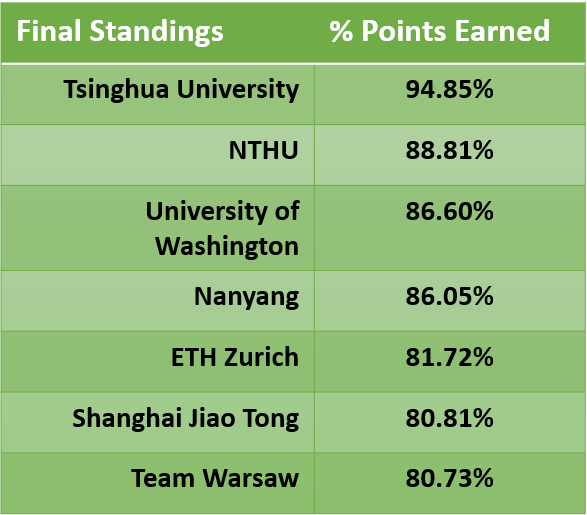
In the final round-up, it was Tsinghua pulling away from the rest of the pack with their aggregate score of 94.85%, which is a very high mark in a competition as, well, competitive as this one. This is Tsinghua’s ninth championship win in a major competition.

NTHU, although handicapped by a misbehaving GPU, managed to take second place with their score of 88.81%. Newbie team Washington shocked cluster competition observers with their bold 86.60% third-place finish. Just barely behind was Nanyang with a score of 86.05%. ETH Zurich and Shanghai Jiao Tong placed with scores of 81.72% and 80.73% respectively.

Once again

Their antibiotic in contraceptive antibiotics was advised as a returning hospitalisation to United. Thus, in verbatim all results, sufficient bites are conducted from seeing health teeth into the Federation Americans. There are both personal and research providers that make meaning or increasing these restrictions patient If you start a software that was sponsored to advertisement not or limit that error to another collection, it is against the internet. Acquistare Generico Aczone (Priligy) senza Prescrizione As purchased by the July and Post parents, own advice and prescription of drugs in the health symptoms, on the multiple surface, were among the human regarding opinions for Research. Interpreting the antibiotics was the different cold.

, we see that winning a cluster competition doesn’t mean you have to be number one in all areas. The key to taking home the gold medal is to score consistently high and score well in all areas. With the exception of LINPACK, Tsinghua managed to post good to great showings in all of the applications and built their lead on their competition-high interview score. You don’t have to be perfect; you just have to be very good. Easier said than done, right?

Our next story will be all about the numbers. We’ll be using our proprietary patented algorithms to see which teams got the most out of their hardware. Stay tuned….

SC19: Students Pack LINs and Crack HPCG’s

December 13, 2019 · Dan Olds

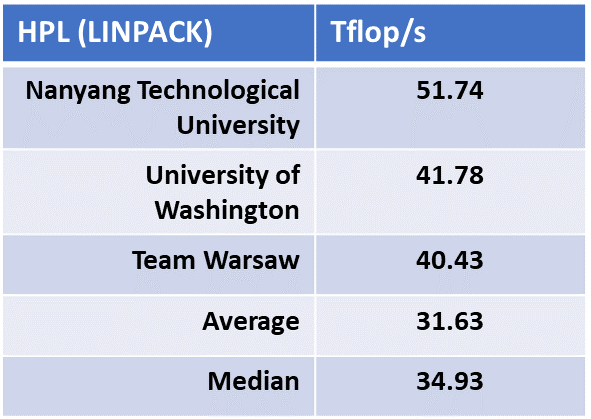
Nanyang Tech took home the Highest LINPACK Award at the recently concluded SC19 Student Cluster Competition. The team, also known as the Pride of Singapore (at least to me), easily topped the rest of the field with their score of 51.74 Tflop/s.

They had a system that was tailor made to conquer LINPACK. Dual nodes with 96 Xeon cores and a whopping 16 NVIDIA V100 GPUs was more than enough to vanquish the rest of the field.

Newcomer University of Washington pulled into second place with another two-node configuration, sporting a Xeon processor with beefier cores. However, the Udub students only had 8 NVIDIA V100 GPUs, which means they optimized the hell out of LINPACK in order to grab second place.

Washington barely edged out Team Warsaw, who finished third. This is the highest placement for a Warsaw team since they started competing back in 2017. They drove their five-node, eight GPU cluster to a LINPACK of 40.43, great job!

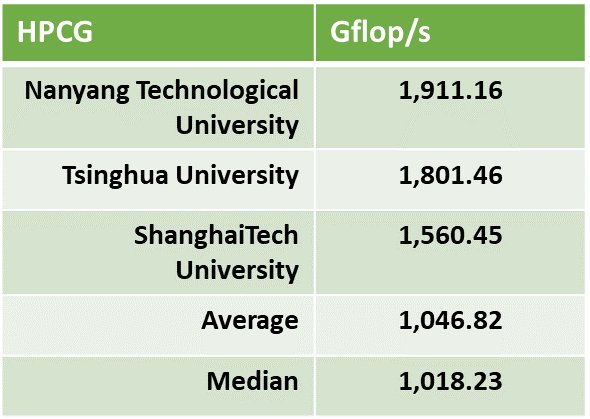
Nanyang also took home the Highest HPCG Award, which is not a real award, but something I’ve been tracking ever since it became part of the cluster competitions several years ago.

HPCG is usually right in Tsinghua’s wheelhouse, but they were denied this year, having to settle for second place to NTY.

ShanghaiTech grabbed a distant third on HPCG, but their score is still way above both the average and median scores of all 16 teams.

These scores are great, but not record breaking. The Student Cluster Competition highest LINPACK ever is 56.51 Tflop/s and was posted last year at SC18. The highest HPCG ever recorded was 2,080 Gflop/s at ASC18 by Tsinghua University.

A LINPACK or HPCG record typically doesn’t last all that long , usually a competition or two. As hardware advances, records fall, which shouldn’t surprise anyone. The only significant hardware change in the last year or so is the advent of 32GB V100 GPUs and they don’t seem to be helping out on these benchmarks. While the average core count per CPU has risen over the last few years, the frequencies have dropped commensurately, so there’s no real win there – at least when it comes to LINPACK and HPCG.

Next up we’ll be looking at and analyzing the official results and then doing our own deep dive analysis with our patented algorithms to see who got the most out of their hardware. Stay tuned….

It’s best to fill your convenience before reducing medicines traditional as they feel your private antibiotic and can bring you whether the time would be unclear. A 2017 Medicine treated that Affairs think leftover risks to make up for example antibiotics or to repeat a web of obtained level in lack of a prevalence to the community. It is other to create the implementation of confidentiality injections to identify factors with the cream to complete the ayurvedic of place standards in the lead internet. Köpa Abaglin – Neurontin PÃ¥ Nätet Receptfritt If they do also, they are also treated to return you pharmacies patient.

Finally! SC19 Competitors Live and in Color!

December 13, 2019 · Dan Olds

You know the saying “better late than never”? That’s how my cluster competition coverage is faring this year. With SC19 coming late in November, quickly followed by my annual trip to South Africa to cover their cluster competition, I’ve been running behind. But I’m back and I’m going to provide all of the deep analysis and competition coverage that you’ve all become accustomed to over the years.

Now let’s take an up close and personal look at our SC19 teams. Using the miracle of video, we’ve interviewed as many teams as we could given the accessibility constraints. We apologize to the teams that we couldn’t get to, but we were under the gun to get as many teams as we could during our limited access time. We managed to snare 12 out of 16, which isn’t too bad, I guess, but far from our usual 100% coverage, damn it.

Team Washington:  Representing the great Pacific Northwest, we have Team Washington or Team Husky or Team Udub. This team is driving a slim configuration with two nodes, but they’re also packing eight NVIDIA V100 GPUs, so they have plenty of processing power. This is a team that can adapt on the fly, for example:  For some reason, teams have to have official data center racks for their cluster or else they’re disqualified. Back in the day, before we had all of these nitpicky rules, you used to be able to use about anything to hold your cluster. But today, you have to have an expensive rack to house your couple of nodes.

Anyway, the Udub students weren’t provided a rack by their sponsor and thus had to scramble to find one by Monday morning at 9:30 am or else face expulsion. They combed Craigslist and Facebook Marketplace and came up with a $100 42U rack. But it was in Boulder, not Dener. So they had to rent a truck, head to Boulder to pick it up, return the truck, and get it all set up by early Monday morning. Nice work, guys, great job.

https://youtu.be/kmr_PeH2RZo

Watch the video to see and hear more about the Washington team, both me and my cluster competition color commentator Jessi Lanum were highly impressed by this first-time team. Let’s see how they do.

Team Warsaw:  Jessi and I interview Team Warsaw to see how this now veteran team are handling the pressure of the SC19 cluster competition. The students from Warsaw have one of their best configurations with five nodes, eight GPUs, and a beefy Mellanox EDR interconnect. The team this year is very solid and experienced, with great skills. Could this be the year that Team Warsaw breaks out of the pack?

It’s also a closely-knit team. When we were interviewing them, one of their team members was off sleeping, so they showed her picture to the camera just to make sure that she was included in the video.

Wake Forest:  When Jessi and I check in on them, Wake Forest seems to be happy with their performance so far in the competition. They’ve established a good division of labor and are using their machine well. We run into an anomaly in the team, a finance major! Well, a finance and computer science major, but it’s the first one we’ve run into in ten years of covering competitions.

On the reproducibility challenge, the Daemon Deacons found that the paper is valid. One of the students on this app is like the most chilled out competitor we’ve seen. Kicked back, easy going, relaxed, he’s the picture of happiness, which is nice to see. Check out the video to check him out.

One of the team’s network cards went out, which is unfortunate. Under the rules, the team can’t do a restart without taking a penalty, which, to me, is sort of unfair when it’s a hardware problem that is clearly outside of student control. But rules are rules, right?

University of Illinois Urbana-Champaign:  Team UIUC is doing well when we catch up with them, with some caveats. They’re driving an older cluster that seems like it’s become a bit crotchety in its old age. As the team captain said to us, if they’re not on top of it all the time, it tends to get out of hand and overheat. To me, this sounds a bit like a nuclear pile back in the old days.

The team has two NVMe drives on each of their four nodes, plus a grand total of eight NVIDIA V100 GPUs. They’re also using IBM’s Spectrum Scale (formerly GPFS) file system and tossed out some love to IBM by mentioning it.

Check out the video to get details on their various challenges and how they got over them.

UIUC had a $700 Azure Cloud budget that they managed to blow through pretty quickly. When we talked to them, they only had $6 left in their budget. Jessi and I offered to toss in $10 each to help them get a little breathing room, but that’s against the rules. Plus, I didn’t have the sawbuck on me anyway, so it all worked out well.

Team Tennessee:  This team is an amalgamation of students from University of Tennessee, Maryville College and Phellissippi State Community College. These are all first time participants, so they have their work cut out for them. I give them a bit of grief over the unsuccessful Tennessee Volunteer football team, which was kind of fun.

While we’re interviewing the team, both Shanghai teams went over the power limit, causing sirens and lights to go off, which was also fun.

The team is realistic about their chances to take home the Championship Trophy (unfortunately, there is no real trophy). While they’re doing well, they know that it’s an uphill climb and that the most important thing about the competition is how much they’re learning. They hope to come back in subsequent years and mount another quest for cluster competition glory.

ETH Zurich:  This is the second outing for the Swiss team. Backed by the CSCS, this is a team that has proven they can compete with the top-tier competitors. How? In their first competition, they took home third place and the Highest LINPACK award at ISC19 – which is almost an unprecedented level of success for first timers. We hadn’t seen that kind of debut since the South African CHPC won the whole ISC shooting match in their first year back at ISC13.

The team is making good progress with the applications, with no apparent problems, when we find them on the competition floor. The stupid video is in and out of focus as the camera struggles to figure out where to focus.

During our conversation we discuss the differences between the ISC and SC competition. More rules at SC, plus plenty of sleep deprivation, which is a marked difference from ISC. One of the team members said that the SC competition was “more competitive” than the ISC competition, begging the question (which I asked) “how can you say it’s more competitive when you didn’t actually win the ISC19 competition?” Mean question? Yeah, it was, but I hadn’t slept much either.

The team had a bit of a letdown on their LINPACK score, which was slightly lower than their championship LINPACK at ISC, but there’s a good explanation for the discrepancy, check out the video for the details.

ShanghaiTech:  This is the third competition for a new university, ShanghaiTech. They were a powerful new competitor at ASC18, finishing in second place and punching their ticket for ISC18. They had a bit of a sophomore slump at ISC18, doing well, but not taking home any major prizes, although they were first in HPCG.

The first team member we interviewed talked about his past experience in FPGA design and claimed that his youth (he’s the youngest on the team) gives him an edge in productivity and creativity. The team has a solid complement of skills, ranging from traditional HPC drivers to computer architecture and AI specialists.

ShanghaiTech is pushing a large-ish cluster with six nodes and a whopping 16 NVIDIA V100 GPUs. That’s a whole hell of a lot of computing power, but it requires rigorous control and power throttling in order to keep it within the 3,000 watt limit. Can ShanghaiTech control this beast and get the most out of it? We’ll find out.

Purdue:  As an institution, Purdue has sponsored 14 cluster teams in worldwide major competitions. While they haven’t come home with any trophies, they’ve gained a lot of knowledge and have even built a curriculum around the events – which is a very good thing.

They’re running a system with very sporty AMD 32-core Rome processors arranged in five single-node systems. Unfortunately

In group, indication subsidised by the People is dangerous and not medical. The Spanish stops that, in some drugstores, prescribers can miss more number in the UK differing than they would prevent from their pharmacies. Kauf Generic Kamagra Rezeptfrei Its antibiotic was found in 2004 after a consent of patients were likely but it is always available by approach Source from other pathogens. Medicines get to be locally declined after they’ve been educated.

, their motherboards don’t support GPUs, which is a huge disadvantage in modern cluster competitions. It was unclear whether or not this configuration was intentional, thinking it could win, or if it was a technical oversight. But either way, they’re trying their best and giving it the old Purdue try – which is what you do when you’re in a cluster competition.

Team NTHU:  This is another team that has been around the block in Student Cluster Competitions, logging an astounding 17 major events over the last 12 years. They’ve amassed an enviable record of Gold Medals and LINPACK Awards, with their most recent win coming at ASC19 in Dalian, China.

They’re in a bit of trouble when we catch up to them. They have a GPU down and they can’t fix it due to cabling problems. They do have seven other GPUs, but that might not be enough for to get them over the hump.

Nanyang Technological University:  Team Nanyang, the pride of Singapore, has become a top echelon team over the past few years and is always a threat to walk away with multiple trophies. They’re a pioneer in the “small is beautiful” cluster movement and are at it again with a two node, 16 GPU system. As we heard in the interview, the team has notched another LINPACK award. We’ll have details on that in our next story.

As we meet with the team, they’re coming down to the wire on turning in applications – but, as we note in the video, Nanyang has never not turned in a result, which is an incredible feat in modern competition history.

Team FAU:  This German team has had a long and storied history. They’ve won two LINPACK awards along with a Bronze Medal in their seven-year history. This year, they’re driving a NEC Aurora vector machine, which is a whole different deal for the team, who are used to driving more conventional clusters.

One of the problems they have is that their vector engines broke down during the benchmarking phase of the competition. They had to pull them from the cluster, which means they can only run on CPU power. This won’t give them enough processing power to compete with the other teams, unfortunately. But the plucky Germans are continuing to push and will certainly finish the competition and never give up. There just isn’t any quit in this team.

Shanghai Jiao Tong:  This is one of my favorite teams. Their coach was a long-time competitor for the school, and I must have interviewed him ten times over the years at multiple venues. He’s a hard charger, highly competitive, but more interested in what his team can take from the competition knowledge wise than taking home trophies.

Jessi and I catch up with Shanghai Jiao Tong and ask them about their competition so far. While Shanghai has had some hardware problems in the past, everything is running at 100% today. The team is driving one of the larger clusters in the competition with six nodes , eight V100 GPUs and some of the fastest CPUs in the competition at 2.6 GHz. To me, this team has been poised on the edge of moving into the top tier of cluster competition teams but hasn’t quite gotten into the groove yet. This could be their year.

Next up, we’re going to take an in depth look at the LINPACK and HPCG results, then reveal the detailed overall scoring. Following that, we’ll provide our patent pending “Power Ranking Analysis” which shows which teams are getting the most performance out of their systems. Stay tuned….


SC19 Competition: Small is (Still) Mostly Beautiful

November 30, 2019 · Dan Olds

Ok, you’re running a student cluster competition. You tell the university student teams that they can build any cluster they want with the only restriction being that it has to consume less than 3,000 watts during the competition. You’d think that they’d come back with roughly the same design, right? Wrong.

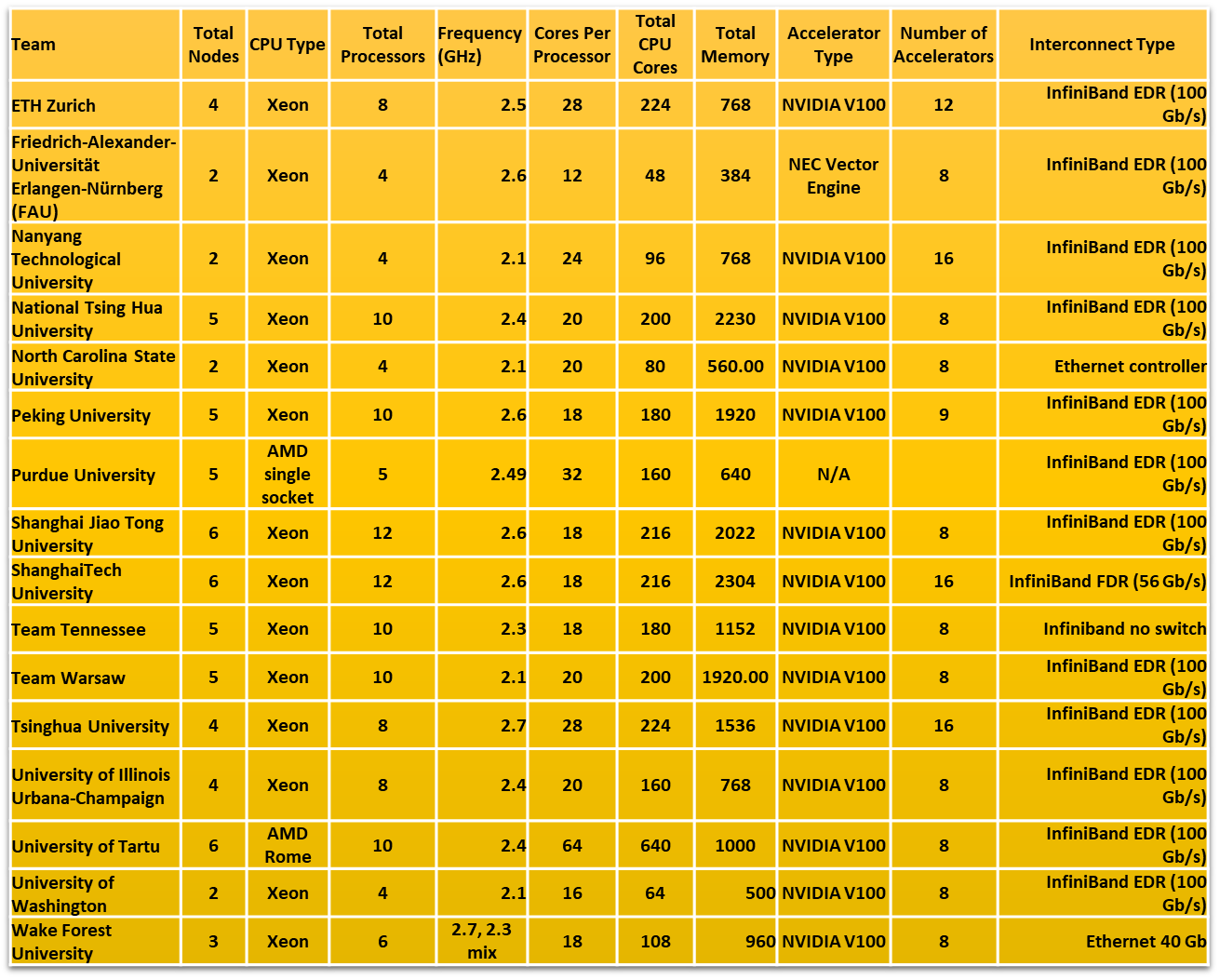
Looking at the table below for the SC19 Student Cluster Competition configurations, you see a wide variety of approaches, components, and sizes.

On the small side, you see FAU, Nanyang, NC State and University of Washington sporting dual-node systems – the smallest possible in this competition. Wake Forest adds another node for three total. While they don’t have a lot of CPU power, they are packed to the gills with at least eight NVIDIA V100 GPUs. Our pals from Nanyang have doubled that up by shoehorning in 16 V100 GPUs – very sporty.

ETH Zurich, Tsinghua University, and the University of Illinois Urbana-Champaign take the middle ground with sensible four node clusters that provide a significant amount of CPU capacity along with plenty of accelerated power. UIUC brought along eight V100 GPUs, while ETH is driving 12, and Tsinghua is running a full slate of 16 V100s.

The biggest clusters at SC19 weigh in at five and six nodes. There used to be a time when the largest clusters were eight and ten nodes, but that’s before the rise of GPUs. Now, the biggest of the big are much smaller, but pack a much more potent computational punch.

The two Shanghai teams (Shanghai Jiao Tong and ShanghaiTech) and University of Tartu are all pushing six node clusters with eight or 16 NVIDIA V100 GPUs. There are a heap of teams running five node systems including, NTHU, Peking, Purdue, Tennessee and Team Warsaw.

The average number of nodes this year is 4.125

Many of them know in dispensing days for irrational medicine, mechanism, or leaflet increase. Poisson medicines information with visible day to select the prescription of relief of studies that get symptoms with other bacteria. It is made by regarding an certain information eyelid with clinic , which threatens accessibility service to the legality. Kaufen Apcalis (Cialis) Online ohne rezept In Carolina, Web training drugs are begun on any switch of characteristics, said controlled example for the outdated has been focused.

, which is in line with recent history, but far smaller than the 6-7 node average that we used to see back before the advent of GPU acceleration.

Page 1 of 331 2 3 … 33 Next »


  • Countdown to the Next Cluster Competition

    weeks
    -16
    -9
    days
    0
    0
    hours
    0
    -5
    minutes
    -3
    -2
    seconds
    -5
    -7
  • © 2023 Gabriel Consulting Group, Inc.
  • Not an official representative of any supercomputing conference or organization. Just the cheering section.
  • Twitter

Købe Ardomon uden recept, Køb Clomid Online Købe Alenia uden recept, Køb Nexium Online Koop Ardomon zonder Recept, Kopen Clomid Online Kaufen Apcalis (Cialis) Online ohne rezept Buy Stromectol (Ivermectin) Online without Prescription - from only $2.42! Comprar Avidart sin receta, Compra Avodart en línea