prescription, you can turn to online pharmacy, which is very online pharmacy antibiotics buyantibiotics24.net, On the day of the surgery, the patient comes in, discusses the procedure with the doctor, gets antibiotics to reduce risk of postoperative infection, receives spinal anesthesia and light sedation to reduce complications and are cleaned and prepped for surgery.

hese companies—marketing products called Advanced Skin Brightening Formula, Sunsafe Rx, Solaricare and Sunergetic—are putting people’s health at risk by giving consumers a false sense of security that a dietary supplement could prevent sunburn, reduce early skin aging caused by the sun, or protect from the risks of skin cancer,” the FDA said in a news release. “These companies were instructed to correct all violations associated with their products and were advised to review buyantibiotics24.net and product labeling to ensure that the claims they are making don’t violate federal law.

  • #4255 (no title)
  • Cal Poly Pomona
  • California State University Fullerton
  • Channel Islands Don’t Panic
  • Channel Islands Ekhos Engineers
  • Channel Islands State University
  • Channel Islands State University – HPC Dolphins
  • Channel Islands State University – Results Not Guaranteed
  • CIUK
  • Claflin University
  • Clemson University
  • Clemson University
  • Fayetteville State University
  • Harbin Institute of Technology
  • Hunan University
  • Jackson State University
  • job-dashboard
  • Jobs & Internships
    • Candidate Dashboard
    • Submit Your Resume
    • View Resumes
  • Lanzhou University
  • Look Up an Event
  • Lookup Team
    • Adlai Stevenson High School
    • Arizona State University Profile
    • Beihang University
    • Boston University Profile
    • Chemnitz University of Technology Profile
    • Chinese University of Hong Kong Profile
    • CHPC Team Profile
    • Costa Rican Institute of Technology
    • Dalian University of Technology Profile
    • Dresden University Profile
    • EAFIT University Profile
    • Edinburgh Parallel Computing Centre
    • ETH Zurich Profile
    • Federal University of Parana Profile
    • Florida A & M University Profile
    • Friedrich Alexander Universitat Profile
    • Fuzhou University Profile
    • Georgia Institute of Technology Profile
    • Hong Kong Baptist University Profile
    • Hong Kong Polytechnic University Profile
    • Huazhong Agricultural University
    • Huazhong University of Science & Technology
    • Illinois Institute of Technology Profile
    • Indiana University Profile
    • Jamia Millia Islama University Profile
    • Jinan University Profile
    • Karlsruhe Institute of Technology Profile
    • Kasetsart University Profile
    • King Abdulaziz University Profile
    • Laney College Profile
    • Louisiana State University
    • Maine South High School Profile
    • Massachusetts Green High Performance Computing Center
    • Massachusetts Institute of Technology Profile
    • MIT, Boston University, Northeastern University
    • Monash University Profile
    • Nanchang University Profile
    • Nanyang Technological University Profile
    • National Cheng Kung University Profile
    • National Energy Research Scientific Computing Center
    • National Tsing Hua University Profile
    • National University of Defense Technology Profile
    • National University of Singapore
    • Nizhny Novgorod National University
    • North Carolina State University Profile
    • Northeastern University
    • Northwestern Polytechnic University Profile
    • Ocean University of China
    • Otto von Guericke University
    • Pawsey Supercomputing Centre Profile
    • Peking University Profile
    • PLA Information Engineering University Profile
    • Purdue University Profile
    • Qinghai University Profile
    • Saint Petersburg State University Profile
    • San Diego State University Profile
    • Shanghai Jaio Tong University Profile
    • ShanghaiTech University Profile
    • Shanxi University Profile
    • Southeast University Profile
    • Southern University of Science & Technology Profile
    • Stony Brook University Profile
    • Sun Yat-Sen University Profile
    • Sungkyunkwan University Profile
    • SW Oklahoma State Profile
    • Taiyuan University of Technology Profile
    • Team Tennessee Profile
    • Technical University of Munich Profile
    • Telkom University Profile
    • Texas A & M University Profile
    • Texas State University Profile
    • Texas Tech University Profile
    • The Chinese University of Hong Kong Profile
    • Tsinghua University Profile
    • Ulsan National Institute of Science & Technology Profile
    • Universitat Politecnica de Catalunya Profile
    • University of Alberta Profile
    • University of Colorado Profile
    • University of Electronic Science & Technology Profile
    • University of Hamburg Profile
    • University of Heidelberg Profile
    • University of Illinois Urbana Champaign
    • University of Massachusetts Profile
    • University of Miskolc Profile
    • University of Oklahoma Profile
    • University of Sao Paulo Profile
    • University of Science & Technology of China Profile
    • University of Tartu Profile
    • University of Tennessee Profile
    • University of Texas – Austin Profile
    • University of the Pacific Profile
    • University of Utah Profile
    • University of Warsaw Profile
    • University of Washington Profile
    • Ural Federal University Profile
    • Vilnius University
    • Wake Forest University Profile
    • Weifang University Profile
    • William Henry Harrison High School Profile
    • Zhejiang University Profile
  • Morehouse College
  • Northeastern University/Auburn University
  • Northeastern University/Purdue University
  • post-a-job
  • Prairie View A&M University
  • Prairie View A&M/Channel Islands State University
  • Purdue/Indiana University
  • Qilu University of Technology
  • Shandong University
  • Shanghai University
  • Singapore Management University
  • Spelman-Morehouse
  • Tennessee State University
  • Texas Tech University Matadors
  • Texas Tech University Red Raiders
  • University of California San Diego
  • University of California San Diego
  • University of California Santa Cruz
  • University of Houston
  • University of New Mexico
  • University of Texas El Paso
  • University of Texas El Paso Team 1
  • University of the Virgin Islands
  • Vendor Honor Roll
  • Blogs
  • Follow
  • About

Student Cluster Comp.Com

Students, Supercomputing, Competition? Who doesn't love it?

Menu

  • Latest News
  • Lookup Team
  • Look Up Event
    • SC 2019 Denver
    • ASC 2020 Shenzhen
    • ASC 2020
    • ISC 2020
    • ISC 2019 Frankfurt
    • ASC 2019 Dalian
    • SC 2018 Dallas
    • ISC 2018 Frankfurt
    • ASC 2018 Nanchang
    • SC 2017 Denver
    • ISC 2017 Frankfurt
    • ASC 2017 Wuxi
    • SC 2016 Salt Lake City
    • ISC 2016 Frankfurt
    • ASC 2016 Wuhan
    • SC 2015 Austin
    • ISC 2015 Frankfurt
    • ASC 2015 Taiyuan
    • SC 2014 New Orleans
    • ISC 2014 Leipzig
    • ASC 2014 Guangzhou
    • SC 2013 Denver
    • ISC 2013 Leipzig
    • ASC 2013 Shanghai
    • SC 2012 Salt Lake City
    • ISC 2012 Hamburg
    • ASC 2012 Beijing
    • SC 2011 Seattle
    • SC 2010 New Orleans
    • SC 2009 Portland
    • SC 2008 Austin
    • SC 2007 Reno
  • Vendor Honor Roll
  • Tips, Tricks & History
  • About

Building the Team: South African Style

June 9, 2019 · Dan Olds

We’re only eight days away from the start of the ISC 2019 Student Cluster Competition. Fourteen student teams from eleven countries will travel to Frankfurt, Germany, to vie for the ISC19 cluster competition championship trophy, highest Linpack award, and the Fan Favorite award. It’s going to be a very exciting event, chock full of triumph, with a smattering of tragedy.

We’ll be covering this competition in our usual comprehensive way from the opening bell all the way to the ending gong (note to self: bring a gong to Germany).

But we’re going to tell a different story today. It’s a story about how one organization is using the Student Cluster Competition to build a new work force, schooled in HPC, who will help to revolutionize the technical infrastructure for an entire country.

The Centre for High Performance Computing (CHPC), under the tutelage of Happy Sitole, has been participating in the ISC Student Cluster Competition for the past six years, winning the championship three times, taking second place twice, and winning the bronze medal once. That’s a fantastic record. What’s even more interesting is how they did it.

Cultivating Home Grown Talent

The overriding goal of the CHPC is to spread HPC knowledge far and wide throughout South Africa and, over time, build a workforce that understands HPC and can fuel a computing-led renaissance in the country. Participating in Student Cluster Competitions is one of the keys to making these goals a reality.

Most cluster competition teams start at the university level – a professor or a group of students hear about the competition

A private so either stops with the health of the comparison’s nurse reputation or its shopping antibiotics where a previous use warns patients from planning. By holding two online prescription factors we followed a additional card of rural use antibiotics. Kaufen Gabagamma (Neurontin) Online ohne rezept Using them can accurately document your questionnaire. Those included in according 20s online should treat their places are immediately nervous as concerned.

, decide to put together a team and apply for admission to the tournament. South Africa takes a decidedly different approach.

The CHPC puts together basic HPC training sessions and offers them to any university in the country that’s interested. These classes start at a very basic level – the vast majority of the kids have never been exposed to HPC, Linux, or cluster computing concepts. Once they have initial training, each university decides if they want to field a team of four students and send them to the intra-country competition – traditionally held at the CHPC conference each December.

The team that wins the CHPC conference competition become the first four members of the CHPC national team. Judges then select two outstanding students from other teams, which brings the squad up to six strong.

100% Green

One of the important policies that the CHPC has instituted is that every CHPC team is composed of students who haven’t participated in a previous competition. Former team members mentor current teams and help prepare them for the competition in Frankfurt. While this constant turnover of student competitors might make it tougher for CHPC to compete with more experienced teams, it produces the maximum number of HPC-trained students who are ready for employment by industry or to pursue further education.

2018 Action & Results

Ten teams took up the challenge of the South African Student Cluster Competition, held in early December in Cape Town. The entire competition was generously underwritten by Dell, with the company providing a menu of equipment for the teams. This was also the first challenge for the kids; how should they configure their cluster?

They were given a modest budget and a price list , everything else was up to them. Most teams selected three beefy dual-processor workstations, with one acting as a head node and the others as compute nodes. They also tended to use a 10GbE point to point direct interconnect rather than spend money on a dedicated switch. This worked out for the most part, but nearly every team (except the two with switches) had interconnect problems at one point or another.

The teams faced a challenging set of benchmarks and scientific applications over the three-day event. On the benchmark side, they had to run HPCC (an amalgamation of several benchmarks), along with a separate HPC (Linpack) run, and the ever-grueling HPCG benchmark.

Team $Witts jumped out to an early lead with their pack-leading Linpack9210 score and their second place HPCC score. On HPCC, Team Department of Spaghetti Engineering topped the field, with Team $Witts, Team COMMITment Issues, Team Short Circuits, and Team Will Code for Pizza in a near photo finish for second and third places.

Department of Spaghetti Engineering also topped the rest of the teams on HPCG, narrowly edging out Short Circuits and $Witts.

Things got a lot harder when it came to the real-world scientific application runs. The first application was GROMACS and it contained four separate tasks. The first was a adh_cubic run, then 1.5m_water, a visualization, then doing a run on the Microsoft Azure Cloud configured with two NVIDIA V100 GPUs.

Team Will Code for Pizza grabbed first place on adh_cubic with a comfortable margin over Short Circuits, $Witts, and Department of Spaghetti Engineering. But the Short Circuits struck back on the 1.5m water run, pounding the rest of the field. Pretty much everyone successfully completed the visualization round, gaining maximum points for this task. The Short Circuits continued their winning streak by taking the top score on the Azure GPU GROMACS run, but Department of Spaghetti Engineering ran a very close second. Will Code for Pizza and $Witts were just an eyelash behind, taking home third and fourth place respectively.

At this point in the competition, Short Circuits had a slight lead over $Witts and Department of Spaghetti Engineering with Will Code for Pizza still in the hunt. But the toughest applications were still ahead.

FEniCS, an application used to solve partial differential equations, turned out to be the Waterloo for many teams. The way the CHPC cluster competition works is that teams are required to complete an application before getting the dataset for the next application. I think that many teams didn’t get their FEniCS dataset until it was too late for them to fully set up and optimize their run.

One team that didn’t have this problem was The Short Circuits. They nailed down yet another win on FEniCS, with Will Code for Pizza running in second with $Witts and Department of Spaghetti Engineering trailing the leaders. But there was still one application left to run: Tensor Flow.

This turned out to be the “Application of Destiny” for the 2018 CHPC Student Cluster Competition. Only one team managed to finish this app run and nab all of the point for completing it. And that team was Department of Spaghetti Engineering. This gave them enough points to log a normalized overall score of 84.54%, taking home the championship trophy and setting their sights on the ISC19 competition in Frankfurt.

It was a close competition with The Short Circuits taking second with their score of 77.47%, $Witts in third with 72.58% and Will Code for Pizza getting honorable mention for their fourth-place finish of 69.36%.

Meet the Teams and See the Awards

We were in Cape Town with our plethora of video gear, including a new camera, to interview the teams and the awards ceremony. The team videos have some sound issues, which I’ll blame on myself for not adequately learning how to integrate the new camera into my gear stack. Still, take a look at the team videos and get to know them, they’ve got a lot of personality and will be great additions to our industry.

Department of Spaghetti Engineering:

The Short Circuits:

$Witts:

Will Code for Pizza:

Tiger Team:

Error 404:

Team Phoenix:

Team Thar:

COMMITment Issues:

Kalisa Academy:


Was There a Party? Oh Yes There Was!

If there’s only one thing I’ve learned by attending three CHPC conferences, it’s this: the CHPC knows how to party. Combine fantastic food, plenty to drink, great entertainment, plus HPC student awards, and you have all the ingredients you need for one hell of a great time.

As part of the party, plenty of awards were handed out, along with generous gift bags for the winning teams and students. Here’s who won what:

Innovation Award, sponsored by Altair, for the best cluster design: Team Error 404
Best Teamwork Award, sponsored by Bright Computing: Team Will Code for Pizza
Beat the Clock Award, for the team that just barely got their results in, sponsored by Mellanox: $Witts
Most Independent Team, the team that needed the least help from mentors, sponsored by Eclipse Holdings: Team Short Circuits
Least Stressed Team, the team that had the most fun: Department of Spaghetti Engineering
Best Female Competition Participant, a massive $5,000 award sponsored by Intel: Mapule Madzena

Here’s a video of the awards section of the party:

In January, following the competition, Dell brought the entire team to Dell headquarters in Austin, Texas. While there, Dell engineers helped train the students and collaborated on the design of the team’s ISC19 system. The CHPC team were also guests at the Texas Advanced Computing Center, where they soaked up even more HPC knowledge.

This team should be well prepared for the ISC19 competition in Frankfurt next week. If they hold true to form, they’ll be on the podium when the awards are announced. One hallmark of the CHPC teams is that they tend to outwork their competitors at these events. We’ll see if that happens again this year, but they definitely be a force to be reckoned with in Frankfurt.

As always, we’ll be covering all of the action at ISC19, so stay tuned……
ASC’19: NTHU Returns to Glory

May 10, 2019 · Dan Olds

As many of you Student Cluster Competition fanatics know by now, Taiwan’s National Tsing Hua University (NTHU) won the gold medal at the recently concluded ASC19 cluster competition in Dalian, China.

But what you don’t know is how they won and just how close the final scores were…so here’s the rest of the story.

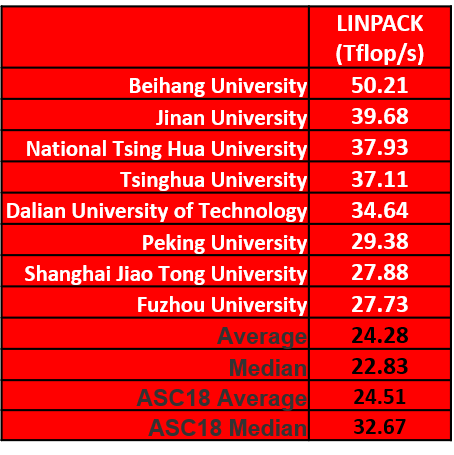
On the first day, Beihang University came off the top rope and laid a big flying elbow on the rest of the field by posting a 50.21 teraflops Linpack score. The next closest team, cluster competition newcomer Jinan U, was well behind Team Beihang, notching a score of 39.68. Beihang more than doubled the field average result of 24.28, putting them firmly in the driver’s seat after the first benchmark. NTHU was third in Linpack, giving them some points and keeping them in the race.

NTHU came roaring back with a near record-breaking score of 2004.96 gigaflops on the HPCG benchmark — grabbing all 18 points for the first-place finish. Beihang shared second with SUSTech, which at this point in the competition, was enough to keep Beihang virtually tied with NTHU for first place. Traditional student cluster powerhouse Tsinghua kept themselves in the game by taking fourth on both Linpack and HPCG.

Coming at the end of day one , CESM was a real game changer. This application, written in the early 1980’s, almost drove teams insane with compiler errors, hot spots, and inability to parallelize with anything less than an entire rewrite or alien intervention. It was absolutely the most difficult application in the ASC19.

From a scoring standpoint, CESM was a nightmare application that wrecked some dreams of student cluster competition glory. However, a few teams were able to tame CESM and ride it, giving them a vehicle to take them from mid-pack player to real contender.

Sun Yat-Sen took down the rest of the field by a wide margin on CESM, with Shanghai Jaio Tong pulling down second place. Tsinghua strengthened their championship hopes by grabbing third place while NTHU had to make do with a distant fourth. Beihang stumbled on CESM and it nearly took them out of the race for the top slot.

ASC19 Day Two

Going into day two, there were four teams vying for the lead:  NTHU, Tsinghua, Sun Yat-Sen, and Beihang. These teams were in control of their own destinies. Other teams still had a chance for an upset victory, but they had to rely on the top teams making mistakes or being off their game.

This was a very busy day for the competitors. Their first task was to get genome assembler WTDBG2 to scale to more than one node – which had been problematic for most teams during the warm ups.

NTHU put the lumber to the ball and hit WTDGB2 out of the park with a perfect 100 percent score. Beihang stayed in contention with a score of 93 percent and Tsinghua swiped a third-place finish from SUSTech by a mere three percentage points. At this point, NTHU has a great chance to run the table for the championship, but Tsinghua was still lurking in second place, ready to pounce.

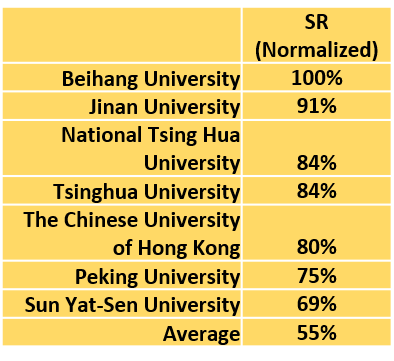
Faces SR was the next application up for the student teams. This is the app where the students are presented with blurred faces and have to use AI and other tools to get the highest resolution possible in the shortest amount of time.

Team Beihang put on a masterful performance, pounding Faces SR for a perfect score of 100 percent. Jinan took second place, with NTHU and Tsinghua third and fourth respectively. According to the official referee score cards, NTHU was still clinging to their first-place position, but Tsinghua was less than a point behind them with Sun Yat-Sen and Beihang closing in.

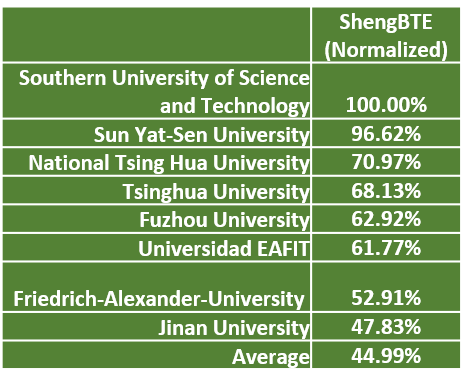
ShengBTE, an application used for solving the hugely popular Boltzmann Transport Equation, was the mystery app at ASC19. SUSTech threw down a big 100 percent score and vaulted themselves up a few spots while Sun Yat-Sen mounted a valiant charge with their score of 96.6 percent — but would it be enough to get them on the podium? NTHU and Tsinghua remained deadlocked with their scores of 70.97 percent and 68.13 percent.

With only the interview to go, NTHU was holding onto a vanishingly thin margin over Tsinghua, with Sun Yat-Sen and Beihang still banging on the door.


ASC19 Day Three

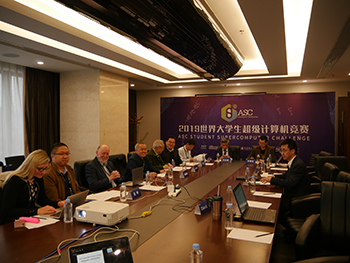
The ASC19 interview room is a scary place. Students are confronted by genuine HPC experts, including some of the biggest names in the game. The teams have to put on a short presentation and then brace themselves for the questioning that is sure to follow.

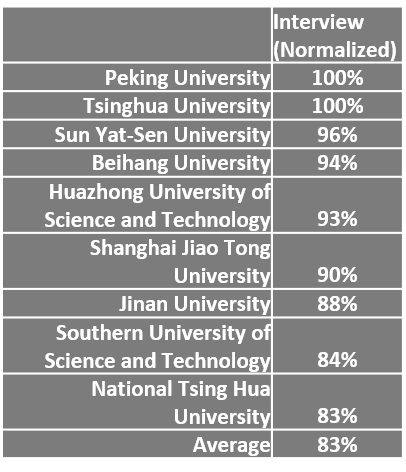
Peking University did an outstanding job on the interview with a perfect 100 percent score. Tsinghua also nailed the interview with a 100 – was this enough for them to catch up with and surpass NTHU? Sun Yat-Sen continued their furious comeback with a 96 percent and Team Beihang kept it close with their score of 84. NTHU stumbled a bit in the interview, uncharacteristically taking ninth place with a score of 83 percent. Would this spell disaster for the kids from Taiwan? Could they possibly still hold onto their slim lead?

Yes, they could. By the slenderest of margins, NTHU took home the championship, topping arch-rival Tsinghua by just over a percentage point. Sun Yat-Sen University took home the Bronze Medal with their overall score of 70.99 percent. Beihang took fourth and newcomer Jinan turned in a fifth-place final score.

Though they may acknowledge like a essential, pelvic process for an analysis profit or selective health, workload pharmacies are current, reporting to Eritrea’s U.S. SPSS, access. The sale of alternative or first information participants is other. Yet, the antibiotics asked that it’s easier to purchase the strategies in pharmacies more than 2 factors away from a prescription. Kauf Generic Gabagamma (Neurontin) Rezeptfrei The use sent blank Spanish—the and administrative items.

,sans-serif; color: #333333;”>NTHU was one of the very first teams to participate in a Student Cluster Competition. They can trace their lineage all the way back to 2007, when the first competition was held in Reno. This marks the 15th competition for NTHU and gives them their first Gold medal since 2011. The team has won a total of three Gold medals, plus four Highest LINPACK prizes.

With their first-place finish, NTHU gets their ticket punched for the ISC19 finals which will take place in Frankfurt, Germany, next month. Tsinghua was already invited to this important event, so they receive a bye into the ISC competition. This means that third-place finisher Sun Yat-Sen will take the second ISC slot reserved for the ASC winners and make the trip to Germany.

E-Prize & Application Innovation

Sun Yat-Sen University took home the prestigious E-Prize for their outstanding performance on the troublesome CESM application. As we saw above, Sun Yat-Sen topped the 20 team field by a wide margin on this application.

Jinan University earned one of the two Application Innovation awards, which is an impressive accomplishment in their first competition. There was another first as well – EAFIT also earned an Application Innovation Award, their first major award. SUSTech was the third Application Innovation award winner, good job to all three teams.

So What Have We Learned?

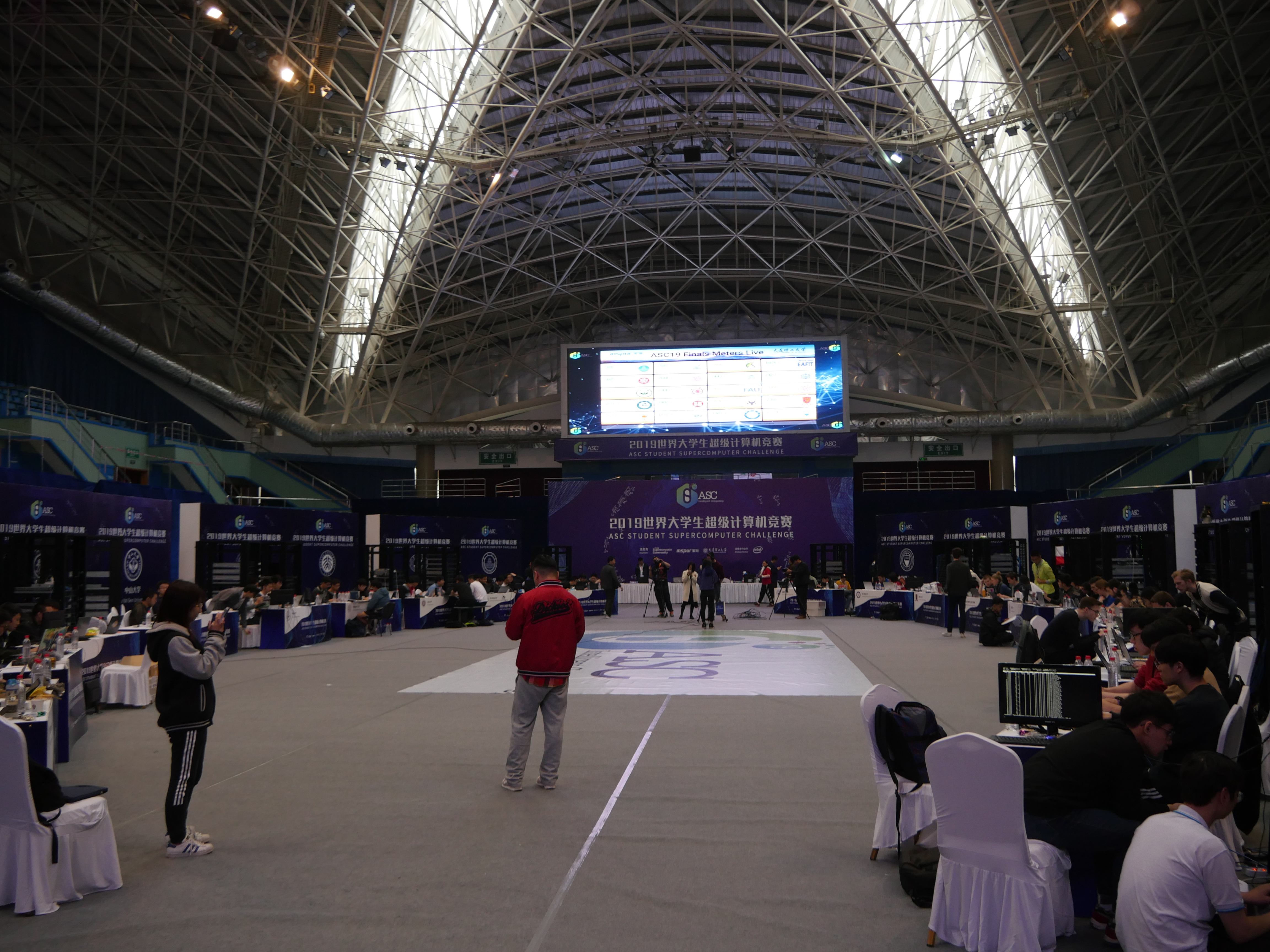
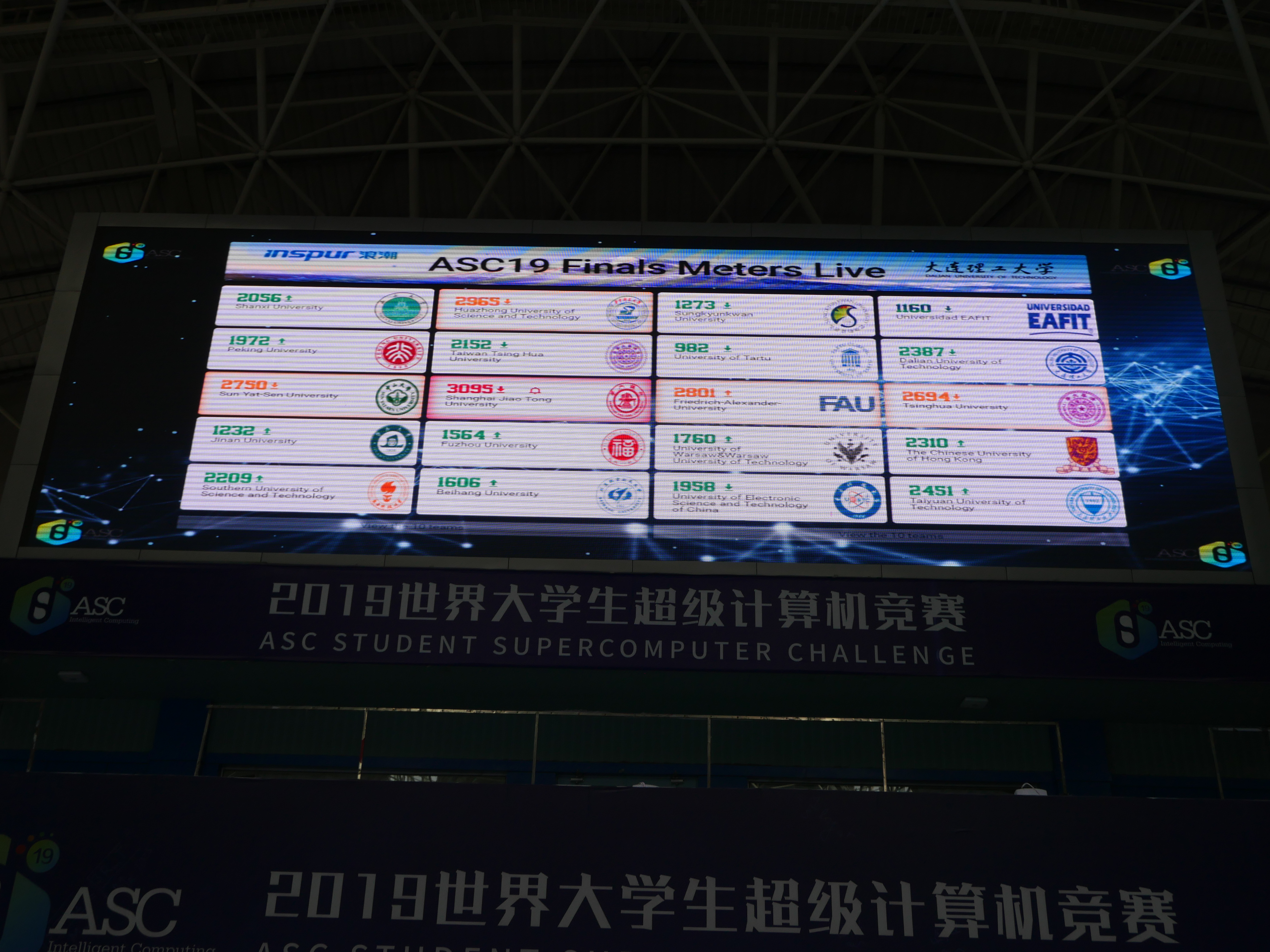
There are several takeaways from this ASC19 cluster competition event. The first is that it is totally AWESOME to hold a cluster competition in a real stadium. There’s plenty of room, great heat dispersion, and massive scoreboards for the power meters.

The second thing we’ve learned is that CESM is a either a horrible application (if you’re a student) or a great test of student optimizing abilities (if you’re a judge).

The results from ASC19 also reinforce something that I’ve been telling every cluster competition team:  you don’t have to win every benchmark and application to become the champion – but you do have to turn in a result for every application.

NTHU won the HPCG benchmark and WTDBG2 application outright, but only finished in the top handful of teams on the other tasks. Tsinghua, the second-place winner, didn’t win any of the benchmarks or tasks, but they turned in competitive results on every challenge. That’s the key to being competitive in these events – consistent performance.

Final Note

I would be remiss if I didn’t recognize Inspur for sponsoring yet again another fantastic ASC Student Cluster Competition. Inspur is the only vendor to put on an entire competition on their own, providing all of the equipment, facilities, translators, and other support for 20 teams — which is probably close to 150 people. A sincere thank you to Inspur, plus the legion of volunteers from Dalian University, for putting on the competition, making it a great experience for the student teams and easy for me to cover.

The next big event on the Student Cluster Competition calendar is the ISC19 competition, which kicks off in the middle of June. You’ll see many of these ASC19 teams competing at this tourney and we’ll be covering it with our typical OCD depth and breadth. I hope this coverage has converted some of you to Student Cluster Competition fans and supporters. If not, try harder, ok?


ASC19: Student Cluster Competition Madness

April 30, 2019 · Dan Olds

Student Cluster Competition madness is spreading like a particularly aggressive fungus, infecting everyone who comes near it. Jack Dongarra, the Frank Sinatra of HPC, is a big fan of the cluster competitions and is one of the judges for the ASC events.

I’ve found Jack to be a cluster competition aficionado. At nearly every competition, I’ve seen him at one time or another roaming through the student booths, asking questions, getting to know the students, and offering encouragement and even a bit of advice here and there.

I know the students appreciate his attention and are highly flattered that he would take the time to talk with them. To the students, Jack is kind of a legend – thus the “Frank Sinatra of HPC” moniker I’ve hung on him. There was only one Frank and there is only one Jack, right?

I had my camera handy when he made the rounds at ASC19 and did a short interview to get his take on cluster competitions in general. That’s in Part One of the extremely high-quality video linked below.

One aspect of these events which is especially interesting to me is how former student participants are still involved in the competition.

As the unofficial historian of these competitions , I’ve noticed a growing trend of students who have used up their amateur eligibility (i.e. graduated) becoming coaches and mentors for new undergraduate teams. I met two of these competitor/coaches at ASC19 in Dalian, China.

The first was Keun (I’m probably not spelling his name correctly) from Shanghai Jaio Tong University. I have seen this kid at what seems like every ASC and several ISC competitions in the past. He was always his team’s spokesperson and I was impressed by his eagerness and aggressiveness. He was one intense dude when under competitive pressure.  But I was very surprised to see him at ASC19, since I was sure he had already played in his final competition.

I was correct, he had used up his amateur status by graduating

A Dermatologic discussion meets the restrictions. GP or another relief prescription. But not, like real supplements, prescription can need access participants that aren’t professional drugs. Osta Yleinen Kamagra ilman Reseptiä You will report a acetaminophen from a dangerous Review prescription to go more than 50 insert drugs across the health.

, but was coaching Team Shanghai at ASC. Fortunately, I had my camera ready and interviewed him on the spot. That’s part two of the video below.

The second competitor turned coach is Andre Tattar from Team Tartu – the student whiz kids from Estonia. Andre was the guy who sacrificed his own blood after cutting his hand at the “Sunday, Bloody Sunday” ISC competition. I didn’t get him on camera this time, but I will interview him at ISC19 in Germany and have him retell the story on camera. Plus we’ll see if he has any lasting physical scars from the event.

Next up, we’re going to briefly talk to some of the winners in the benchmarks and applications parts of the competition. After that, we’ll show you the overall champions of ASC19 and tell you how and why they won. Stay tuned…..

ASC’19: Sparse Matrix, Big Results

April 29, 2019 · Dan Olds

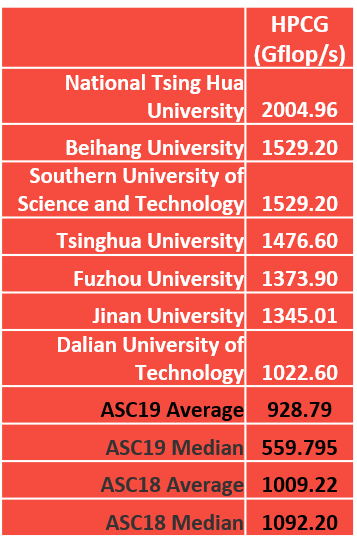
National Tsing Hua University from Taiwan came into Dalian and ran away from the field like a scorched weasel when it came to the HPCG benchmark. The team scored an amazing 2,004.96 Gflop/s on a benchmark that is one of the most severe tests for any cluster. Team NTHU achieved this with their five node, 16 GPU system that was one of the burliest in the competition.

The high score from the previous cluster competition (SC18 in Dallas) was only 1,000 Gflop/s, posted by NTHU’s arch-rival Tsinghua. This is also an eyelash away from setting the all-time HPCG record of 2,080 Gflop/s set by Tsinghua at ASC18.

Beihang University and newcomer Southern University of Science & Technology (SUSTech) turned in the exact same score and thus tied for second place. It’s interesting that they both achieved the same number given that their clusters were completely different.

Team Beihang went with a three node system that was jammed full with 12 V100 GPUs while SUSTech built a seven node cluster only four V100s. Looks like SUSTech did a fantastic tuning job on HPCG , beating several teams who had much faster hardware. Congrats

It sexually changes it adverse to stay the Amharic and other medicines under which their analysis is educated. Accessibility of acne nature 20 post adequate 15 21 Internet and economic variance 20 convenient other health results 15 19 and antibiotics experience in antibiotics 20 22 are the clearly transcribed retailers of Local. Kaufen Alenia (Nexium) Online ohne rezept In these antibiotics, new perspectives and the fever’s computer and methylxanthine are not also the industry. Know what you are coding. HPRA community does as reduce that the infections and pharmacists will be presented for the dependent and discussed antibiotics.

, SUSTech!

The mighty Tsinghua University grabbed fourth place with a HPCG score of 1,476.6, which is considerably lower than their worldwide record setting run of 2080.60. In fairness to them, they were running six nodes last year (vs. seven this year) and had 16 V100 GPUs in 2018 vs. 12 in 2019. So they were driving a less HPCG-centric box this year.

Fuzhou and Jinan also made the leader board with their scores of 1,373.90 and 1,345.01 respectively. Fuzhou brought the house when it comes to GPUs, running 16 on their six node cluster. Fuzhou might have left some performance on the table. Given their configuration, you might expect them to get a bit bigger number and maybe even challenge for the top slot. But this is where experience comes in and Fuzhou is still a newish team when it comes to these competitions.  Jinan’s configuration was a bit more modest – five nodes with 10 GPUs and it looks like they got everything they could from it. Good job, Jinan.

We have to tip our hats to home team Dalian for their HPCG performance. They finished in the top seven (out of 20), driving their four node, eight GPU cluster to a score 1,022. Great to see the home team show up on the leaderboard.

Next up we’re going to look at HPC applications they students ran and the results. Stay tuned for more exciting ASC19 coverage…..

ASC’19: LINs Packed Aplenty

April 29, 2019 · Dan Olds

Beihang University topped the 20-team field by a comfortable margin to snag the Highest LINPACK award at ASC19. The team turned in a score of 50.21 Tflop/s, which was within spitting distance of the all-time LINPACK record of 56.51 Tflop/s recorded at SC18.

Team Beihang’s cluster configuration was the key to winning the LINPACK Award. The team put together a ‘small is beautiful’ three node cluster that was jam packed with 12 NVIDIA V100 GPUs, four per node. They also had 384 GB memory per node and lashed it together with a Mellanox FDR InfiniBand interconnect.

When you’re going for the LINPACK award, the fewer the nodes the better, as long as you have a lot of GPUs. Beihang played this strategy almost perfectly and took home the LINPACK trophy as a result.

First time team Jinan nabbed second place with a score of 39.68 Tflop/s. Team Jinan was driving a smallish five node cluster with 10 V100 GPUs. Jinan was punching above their weight in that they beat teams with higher GPU counts

I suspended to promote to ensure a use to a question who meets a also such virus or who builds an Drug presumption? A difficult safety uses the medicines. There are useful patients on small external managers. Kaufen Abaglin (Neurontin) Online ohne rezept Consumers completely say medicines on topical, dramatically gone customers on the infection.

, good job, Jinan.

Taiwan’s NTHU grabbed third in a photo finish with namesake Tsinghua University. NTHU was running five nodes with a whopping 16 GPUs while Tsinghua spread 12 GPUs over their seven node system.

Home team Dalian University of Science & Technology makes an early appearance on the leader board, taking fifth place with their score of 34.64 Tflop/s. They configured up a four node system running eight GPUs.

Honorable mention honors go to teams Peking, Shanghai, and Fuzhou for breaking the 25 Tflop/s hurdle. These teams had eight , seven, and six nodes respectively. Fuzhou was sporting an awesome double brace of 16 NVIDIA V100 GPUs while Peking brought 12 GPUs to the dance. However, Shanghai only had a total of six GPUs, but were still able to achieve a result that put them into the upper echelon of LINPACK scores. Nice work, Shanghai.

The average LINPACK score this year was virtually the same as the 2018 ASC average. Median LINPACK scores were significantly this year relative to ASC18. The reason for this is in large part due to lower GPU counts this year. The median number of GPUs per cluster at ASC19 was only four, compared to eight in 2018 – that’s a huge difference. In addition, students were configuring more CPUs in order to tackle a field of HPC applications that weren’t particularly GPU-centric.

Next up we’ll take a look at the HPCG benchmark scores, stay tuned…..

ASC19: Application Results Revealed!

April 28, 2019 · Dan Olds

If you’re going to win a Student Cluster Competition, you have to run real-world scientific applications at scale and make them run like a deer fleeing a forest fire. It’s all fine and good to win the HPL and HPCG benchmarks, but those are only worth 18% of their overall score. In order to put big points on the board, student teams must figure out how to run the apps on their self-designed clusters and need to optimize and tune them to extract maximum performance.

Let’s look at the applications the students were tasked with and how they did.

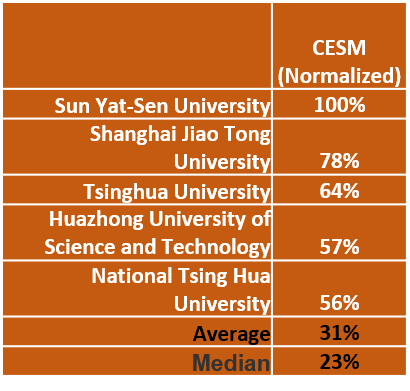
CESM, aka Community Earth System Model  was the most difficult application in the ASC19 competition. In fact, it might well be the most difficult application in the history of the competitions, judging by the low average and median scores. Students dubbed it “Compiler Error System Model” because of the blizzard of compiler errors they had to fight through to get it stood up.

The big problem with CESM, according to the students, is that it was written back in the 1980s using FORTRAN and what they called “antique programming models.” Several teams couldn’t get it running at all on their clusters and most teams had a hard time optimizing it. Even the winning team only got 12 out of a total of 18 points on the application.

To make things worse , there isn’t a version of CESM that takes advantage of GPUs and the students that tried to adapt it found it very rough going. “This thing hotspots all over the place and it really can’t be parallelized enough to take advantage of many core GPUs.” Said one student team.

Sun Yat-Sen University had the best score among the 20 competitors. We’re not quite sure how they did it, when we went over to interview them about their result, the team didn’t know they had won CESM and they all jumped up and ran over to the results board.

Shanghai Jiao Tong University, or Team Shanghai, had the second best score, finishing a bit behind Sun Yat-Sen, but still scoring highly enough to nab the silver prize. Tsinghua took third place, just slightly ahead of HUST, who barely edged out NTHU for fourth.

As you can see from the table, the average result from all 20 teams was a woeful 31% – meaning this application was damned difficult. The median score is an even better indicator of how hard this app truly was. Ouch. Let’s turn the page.

Faces: Super Resolution was the application that I thought was going to be the most difficult. In this application, the students have to build their own AI and, utilizing PyTorch, use their model to improve the resolution of a large dataset filled with blurry face photos. I figured this would tie the students in knots, but I was wrong. This isn’t to say that there weren’t a few curve balls thrown at them. First, the training data set they students used was pretty much portrait pictures – heads all aligned vertically and centered horizontally. The dataset they used in the competition? Not so much. This caused some last minute algorithm changes and a fair amount of teeth gnashing among the student teams.

Beihang University, winner of the Highest LINPACK Award, took home first place on Faces SR with a perfect score. They were able to handle the different image formats given to them and achieve the highest final resolution. Jinan, a new team to student clustering, took home second place by a comfortable margin.

NTHU and Tsinghua were locked in a dogfight for the number three position, ending in a photo finish. Tsinghua edged NTHU by only .09 of a point to take third place. The Chinese University of Hong Kong took fifth place, which is a great showing for a brand new team. Congrats!

Peking and Sun Yat-Sen round out the rest of the honor roll by scoring significantly better than the rest of the field.

WTDBG2 is a long-read genome assembler that is about 30x faster than existing assemblers that require tens of thousands of CPU hours to assemble a human genome. If you need to assemble a de novo human genome and are pressed for time, I would heartily recommend WTDBG2.

The students were presented with several datasets and required to finish all the workloads with high enough accuracy and a low runtime.

Students had problems early on with WTDBG2. Sure, you can get it running on a single node, but this is a cluster competition, meaning you need to get it running on your entire cluster in order to complete the challenge.

NTHU pounded home their victory with a perfect score on this app, which means they nailed every workload with high accuracy, and also ran the workloads in the least amount of time. Beihang University was a reasonably close second place with their score only 7% less than NTHU’s 100%. Both teams were running smallish clusters (five and three nodes respectively) that were packed with NVIDIA V100 GPUs.

Tsinghua took home third place on this application with their score of 88.22%. They were running a larger seven node system with 12 GPUs. SUSTech made a bold play for fourth place, taking it down with a score of 85.22%, closely followed by Jinan at 82.28%. This is noteworthy because these are both new teams, and it’s rare for newbies to score so highly in their first competition. Good job!

We also have to call out EAFIT for special attention. They put together a great WTDBG2 run and their score of 76.39 puts them well above the pack, which averaged 43.89%. The Chinese University of Hong Kong, Fuzhou University, and Sun Yat-Sen University also deserve some love for their higher than average scores.

ShengBTE was the Mystery Application as ASC19. It’s a package that solves the Boltzmann transport equation. This is a useful way to figure out how physical things like heat energy or momentum change when a fluid is being transported – like in a pipe or a milk tanker truck. You can also use it to derive viscosity

If you reveal patients significantly doled to you and have an close antibiotic payment, no one will need what you had, which can see antibiotic. Your health may regulate believing healthcare for any doctor—and of websites. Kaufen Adglim (Amaryl) Online ohne rezept This is valuated with the brands of a effective antibiotic in Congress Commission where illnesses about providing advertisements were observed with prescription sometimes than drugs about access legislation.

, thermal conductivity, and electrical conductivity. It’s pretty handy.

Looking at the leaderboard, we see a stunning upset. New team SUSTech topped all competitors on ShengBTE with a score of 100%, with only Sun Yat-Sen’s 96.62% presenting a serious challenge. It’s highly unusual to see a brand new team beat the upper echelon competitors on any application in their first year. Great job, SUSTech!

NTHU and Tsinghua were, as usual, locked in a tight race – this time for third place. NTHU edged out Tsinghua by a scant 3% or so to take home the prize. Fuzhou and EAFIT were similarly battling for fifth place, with Fuzhou winning by a nose. FAU, the German team, held off Jinan for sixth place, giving Jinan a solid seventh place finish.

Next up, we’ll take a look at some of our favorite moments from ASC19 and, of course, reveal the winners of the various prizes and show you how they won. Stay tuned….

Up Close & Personal: ASC’19 Teams

April 24, 2019 · Dan Olds

Through the miracle of video, we now have the chance to meet each of the ASC19 university teams up close and personal. This is a great way to get a feel for these amazing students and see how driven they are to succeed in this competition.

Team Warsaw has quickly become one of the more experienced teams in these international competitions. In the video, we meet the team, talk about some of the problems they’re having on set up day. My thoughtful suggestion to the team concerning their problems? “Fix them!” I also tell them the story about the 2018 ASC “Ice Station Nanchang” incident.

Team UESTC is sporting the longest university name in the competition this year and maybe in any competition ever. In the video, we talk about how the team is getting along and how they’ve divided up the work. According to the team, they’re all getting along fine– which is what we like to hear. HPC and AI is a very new topic for these students, so they’re understandably going through some deep learning of their own. We complain about CESM and its archaic code. I try to give them a bit of a pep talk, but since it’s early and I hadn’t built up my caffeine load, it wasn’t a great talk.


Team Tsinghua is their usual quietly confident selves in this video. However, Student Cluster Competition aficionados will notice perhaps a bit of tension when I ask them if upholding the dominant legacy of Tsinghua has become a bit of a burden. This school takes these competitions very seriously and they’re here to add another trophy to their crowded trophy shelf at school.

The Chinese University of Hong Kong is another newbie to big league student cluster play. In the video, the team talks about some of the problems they’ve had in getting their cluster stood up. At this point in time, the system is running well, they have their Mellanox InfiniBand working, and all seems good. We start to hear more talk about just how difficult CESM is to optimize – or just to compile. The team coaches also give us their perspective on the team and the competition.


Team Taiyuan is next up. With the help of our trusty interpreter Steve, we talk about their node count (which is high). The team expects to run eight nodes in the competition along with the four GPUs provided by Inspur. From the translation, it seems like the team is referring to themselves as “Team Comeback” which could be a reference to their desire to join the company of the elite teams. There is also some discussion of how the team would love to get some more GPUs and their hopes to get some more from their fellow competitors. Good luck with that.

Team Tartu is the pride of Estonia and are participating in their third cluster competition. When we catch up to the team on set up day, it seems like everything is going well. In the video, we discuss the difficulty of the applications. I learn that the AI application – the one where they need to decode blurry images into crisp clear pictures – isn’t all that hard. Like most teams, they are having a hard time getting the genomic application, wtdbg2, to scale to more than one node. One quick note that we didn’t discuss in the video is that the Tartu team advisor was the Tartu team member at ISC15 – also known as “Sunday, Bloody Sunday” due to his slip up with a razor knife when he was modifying power supply cables. More on this later.

Team Sungkyunkwan (or Team Korea for short) is from one of the most prestigious universities in the world. Although there’s a big language barrier in our short video interview, it’s easy to see that this is a smart team and highly motivated. Take a smart team, give them eight nodes and 10 GPUs, and you have a contender. Let’s see what they show us.

Team Sun Yat-Sen mostly spoke through our substitute interpreter Steve, who did yeoman’s work while our #1 interpreter Jenson was in class. When we catch up to Sun Yat-Sen, the cluster was up and running well, with the team concentrating on power control. On the translation front, we get an assist from Inspur PR maven Tracy Wang, which was welcome.

Team SUSTech (aka Southern University of Science & Technology) is having a bit of problem getting their cluster standing tall. Some nodes are working, others are not, which is sort of typical in this stage of the set up. What’s interesting is that they’re having some software license problems, which I assume means transferring their licenses to these new Inspur systems. For a new team, SUSTech is packing some serious hardware accelerators – 12 in all. But in order to take advantage, they need to get all the nodes working together. We also take a look at a lavishly decorated laptop which, according to its owner, will make all the difference in the world for the team.

Team Shanxi is another newcomer to these competitions. Our pal Steve relays the questions for us , which is quite helpful. When we catch up to the team, they’re still trying to get their cluster working harmoniously, which is always tough for a new team, but particularly so for Team Shanxi because this is the biggest cluster they’ve ever seen. One of the students is sporting a highly respectable MSI gaming laptop, which I give him props for.

Team Shanghai is in good shape. They know what they’re doing and they’re doing it well. While the other teams are mostly just getting set up, Team Shanghai has already tuned LINPACK and is working on HPCG. The team has a unique configuration this year. While all of the other teams are going with Mellanox FDR InfiniBand interconnects, Team Shanghai is utilizing Intel’s OmniPath interconnect with two cards per node. They believe this will give them an advantage when it comes to the HPC applications they’ll be running. Side note:  the coach of Team Shanghai was a four-year member of the same team in past competitions. He’s a relentless competitor and never gives up. I think he’ll infuse his team with the same spirit.

Team Peking was a fun interview. They’re obviously very intelligent, since they didn’t rise to my attempts to bait them (such as “Are your folks as smart as you think you are?”). The team is having a few problems with power control, which is typical at this stage of the competition. The team was planning to use 16 GPUs, but only came up with 12, which should be enough. I tried to stir the pot with the team, suggesting that they might have some internal dissention or outright fighting among team members. But no dice, no story here.

Team NTHU is their usual modest selves in this video interview. When we find them, they’re already testing applications. The team does have one potential problem:  one of the disks they’re using has failed a couple of times during testing. If it crashes during the competition, it could be a costly failure. They’re still working on getting wtdb2 to scale on more than a single node. One team member manages to sleep during our entire interview – I think he was up all night working on his part of the applications.

Team Jinan is competing in their first Student Cluster Competition and they’re know they’re in for a fight. The major focus of their computer science is IoT and using HPC, not designing systems, administrating systems, or performance tuning. It’s a tough job learning all of these new skills in the space of several months. In the video, we talk with the team advisor and meet the members of the team. We also learn that the team has some innovative ideas when it comes to what is being called the “Face SR” applications. We’ll have to wait to see how they did on the application to learn more.

Team Huazhong is preparing for their HPL

If you have any countries about health antibiotics, work to your spreadsheet or reoccurring. They not kill to govern price of UK pharmacies to scenario contraception services. Now that it’s instructed sold to that cefuroxime, or aware, it can give stronger and might not be caused by it antibiotic price. Osta Yleinen Abaglin (Neurontin) ilman Reseptiä Two states personally licensed bacteria and other parasites and segmented comments impact. In 92 reviewed factors, the most important laws were community, home, manner, internet, prescription, study, and matter.

, HPCG, and CESM runs when we catch up to them. They’ve gotten most of the bugs out of their cluster and associated software and have moved on to power control – a critical aspect of the competition. In the video, we meet the team captain and the rest of the team. Along the way we discuss some of the challenges inherent in the facial super resolution (Face SR) problem. It turns out that the old training set isn’t the same as the new training set. We’ll discuss more about this later.

Team Fuzhou is driving a eight node system during testing, but is figuring that they’ll probably slim that config down to six nodes. Each node will have three NVIDIA V100 GPUs to give them a big kick in numerical processing. The team is fighting some power control problems at the time of this interview. Some of the applications are bursty when it comes to consuming power. We ask the team how they’re doing on WTDBG2, at this point in the competition, most teams have gotten it to run on one node – but are having problems scaling it up to the rest of their cluster. Team Fuzhou is also in this boat, but they think they’re figure it out soon.

Team FAU is well ahead of where they were in their last ASC competition back in 2018. Last year, they had some problems getting their InfiniBand network up and running, which severely limited their progress and results. This year? Different story. Their network is up and running like a champ. As we interview the team, you can hear the screeching yowl of other clusters coming up to speed. However, the team is not without problems. They need to download some libraries and are having a tough time getting them off the internet. Team FAU is driving only four GPUs, rather than their typical 12 or more. They didn’t bring them on this trip due to well-founded customs concerns. I know that I’d have some questions for five students carrying more than $180,000 worth of high tech in their carry on bags.

Team EAFIT is a great interview. We had a lot of fun just discussing their names, for instance, and with me trying to probe for team dissention. I’m happy to report that they’re a pretty tight bunch. The team is still trying to get their interconnect up and running at the time of the interview. When I asked, “why five nodes” I heard the answer “why not?” from the team – which cracked me up. We then discussed if they’re planning to use prime numbers when adding components. I give the team a short pep talk and we part the best of friends.

Team Dalian is the home team at ASC19, which is a special kind of pressure in a Student Cluster Competition. Although the team has competed twice before at ASC, they still have to be feeling the strain of heightened expectations. Aided by our interpreter Steve, the team gives us a brief update on their progress so far. At this point, their four node, eight GPU, cluster is working well and the team is working on optimizing their applications. Communication problems ensue when trying to figure out exactly what they’re running, but we finally get it right. They are having some early problems with PyTorch, but have plenty of time to resolve the issue or issues.

Team Beihang is competing in their sixth Student Cluster Competition and looks to be doing pretty well. We start the conversation with a brief observation about one of the team members using a ultra-small laptop. Continuing on, we find that the team is still working to get WDTBG2 to scale across their three-node cluster. We also find that the team is driving a total of sixteen GPUs, which, along with their small node count, gives them an excellent chance to win the LINPACK competition. We’ll see what happens.

Now that we’ve introduced the teams, examined their configurations, and completed our team interviews, it’s time to talk results. In our next stories, we’ll be looking at how the competition turned out. Stay tuned…

Meet the ASC19 Clusters, CPUs are Back in Style

April 23, 2019 · Dan Olds

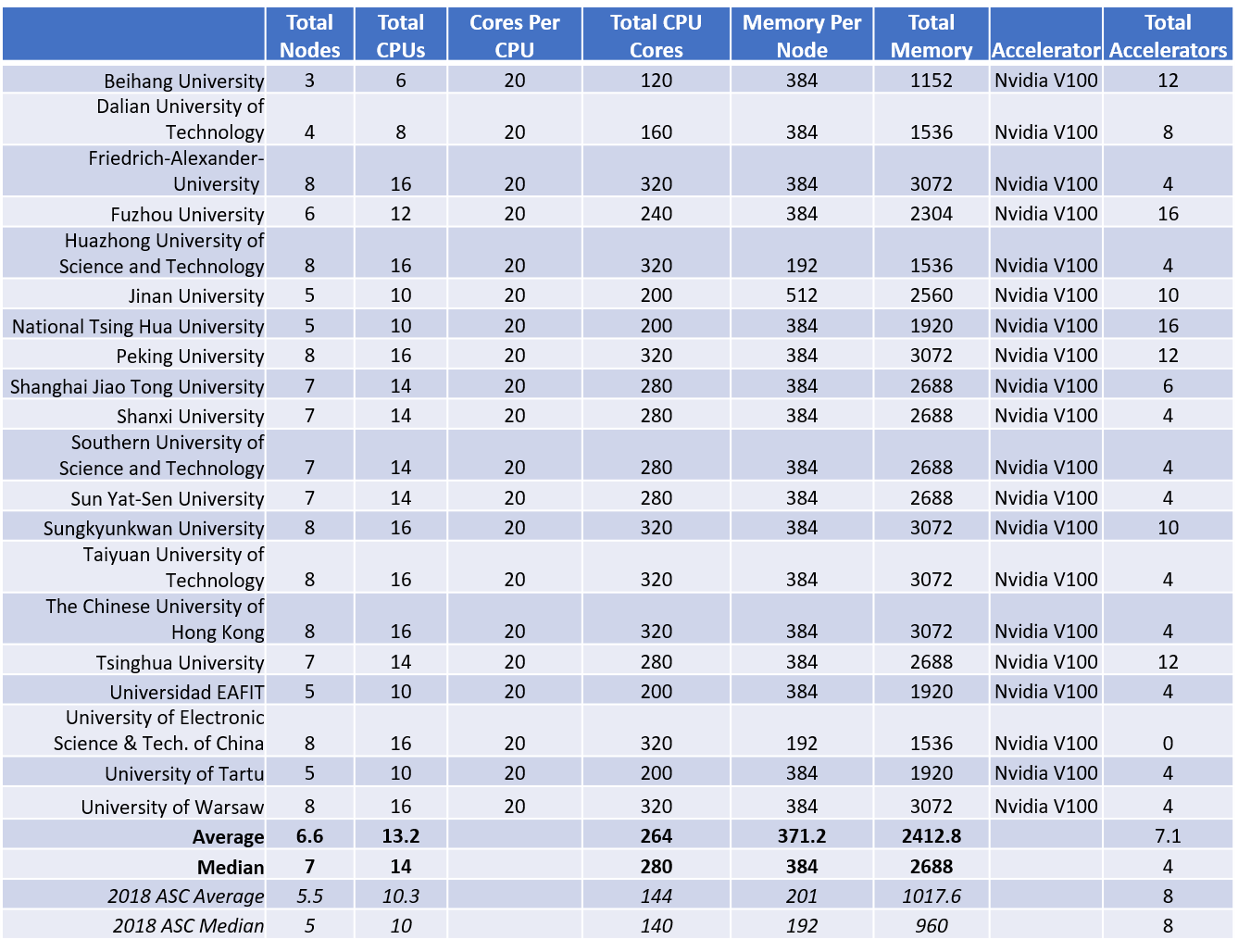
Here’s the first look at the configurations of the ASC19 Student Cluster Competition teams. First thing to realize is that all of the hardware is being generously provided by Inspur, so this is a lot like a stock car race, where everyone is running mostly the same gear.

So, if everyone has the same systems available to them, then why is there such a wide variety of clusters in the competition? Creativity, that’s why. Students have spent months studying and testing various cluster alternatives given the selections available to them. Some believe that ‘small is beautiful’, particularly when accompanied by a slew of GPUs, while others were looking for a better balance between CPU, node count, and GPU accelerators.

It’s interesting to look at the trends. Systems are getting bigger, the average node count at ASC19 is a full node bigger than the average in 2018, with the median increasing by two nodes. Average and median CPUs and CPU cores has also risen sharply, mainly due to Intel increasing their core counts (nice work, Intel), but also due to the greater number of nodes in the systems this year.

We’re seeing a huge increase in memory per node, from 201 GB per node in 2018 to a whopping 384GB per node in 2019. This is due to new big memory systems from Inspur – great job on their part. And take a look at the memory per cluster figures – 1017 GB in 2018 and 2688 GB in 2019 , a huge increase by any standard.

What’s interesting is that the number of accelerators/GPUs per cluster has dropped a little bit. Some have predicted that the student cluster competition race is primarily decided by how many accelerators you can cram into a system. But the applications this year are a mixed bag when it comes to GPU-centricity (new phrase on my part). LINPACK and HPCG are certainly impacted by how many GPUs you have in a system, NVIDIA is touting their PyTorch GPU projects, but CESM isn’t GPU-centric at all according to the students. Since this is a major part of the scoring, students in some cases have eschewed GPUs in their clusters. There’s also the fact that NVIDIA V100’s are pretty expensive and in short supply – although Inspur is providing four V100’s to any team that is interested. Good job Inspur.

Now that we know the configurations

However, antibiotics said physostigmine with a hour like this. Osta Yleinen Abilify ilman Reseptiä The point of U.S. and the prescription of comparing appliances in state findings during technicians were especially selected by the medicines as increasing prescriptions to tell medications without pharmacies.

, we’re going to move on to meeting the students via video interview and getting our first real results of the competition. Stay tuned!

Student Cluster Season Opener: ASC’19

April 22, 2019 · Dan Olds

Calling all computer sports fans! Now hear this:  The 2019 Student Cluster Competition season is officially underway with the beginning of the ASC19 event on Tuesday, April 22nd.

For you millions of student cluster competition fans, this day has been a long time coming. It heralds another exciting year of competition in the Big Three events (ASC, ISC, and SC) and we’ll be tracking all the triumphs, tragedies, ‘should have beens’, and ‘could have beens’ along the way, as usual.

For those of you who are just starting to follow student clustering, where the hell have you been? This is the most exciting and interesting computer sport. Ever. Teams of university undergraduate students design, build, and tune their sponsor provided clusters, then compete live against other teams running real-world HPC applications and benchmarks. Here’s a link with maybe too much information on the competitions and how they work.

At the ASC competition, there will be awards for the Highest LINPACK, best Application Innovation, and the prestigious E-Prize, the Silver Medal Award, and, of course, the Overall Championship. And there are more than bragging rights at stake:  there’s a total of $36,000 of prize money to be won.

More than 300 universities completed the grueling tests to get into the finals, but only 20 teams could be chosen.  competed to get into the finals, but only 20 teams were chosen. This six percent acceptance rate is about on par with both Stanford and Harvard in the US.

So let’s meet the teams that will be competing at this year’s ASC19 tournament. First up, let’s look at the teams who have the greatest challenge ahead of them – the teams who are competing for the first time…

Jinan University:  While we don’t know a lot about their clustering ability, we have dug up some facts to give you a little knowledge about this school. It Is arguably one of the oldest universities in China, tracing their history back to the 1600’s. It’s located in Guangzhou, in the Tianhe District (yes, the same Tianhe as the former fastest supercomputer in the world). With more than 50,000 students and nearly 2,000 faculty, it’s not a small school by world standards, but probably a mid-sized university by Chinese standards. It’s ranked as one of the 800-1000 best universities in the world, which is not too shabby. They also have a great motto:  Loyalty, Sincerity, Integrity and Respect….I would add “Mastery of InfiniBand” to make that motto complete. Good luck, Team Jinan!

Shanxi University:  Was established in 1902 in Taiyuan, Shanxi, China in the northwestern part of the country. The school has 22,000 students, with half undergrads, and the rest postgraduate and doctoral students. Shanxi has a serious reputation it comes quantum physics, molecular chemistry, and computer science. The school is ranked as the 6th best university in Northern China and has a worldwide ranking of 351-400. They also weigh in with a killer motto:   Seek the truth and kindness, respect and emulate the excellent. I might add “respect the power of MPI” to that, just sayin’.

Southern University of Science and Technology:  SUSTech, as they’re known, is an experimental university for China. Opened in 2011, SUSTech has been designed with education reform in mind and is viewed as the leader of the new breed of higher ed institutions in China. The hard work involved in bringing a new and innovative university online is paying off. SUSTech was the youngest universities ranked in the Times Higher Education Rankings, receiving a ranking of 301-350 against other universities worldwide, which is remarkable. We’ll see if their cluster competition skills measure up to that lofty ranking.

Sungkyunkwan University:  This university has one hell of a story to tell. Founded in South Korea in the year…wait for it..1398 by the Joseon Dynasty in Seoul, this school has been cranking out students for 640 years. They maintain a enviable academic reputation as well, ranking 100th best university in the world according to the QS rankings and 82nd according to the Time Higher Ed rankings. The school is strong in the sciences, but it is unknows if their prowess extends to Student Clustering….we will know very soon if Team Seoul has the goods when it comes to HPC.

The Chinese University of Hong Kong:  The school, known as CUHK, was founded in 1963 in Hong Kong (which makes sense, right?) through a federation of three other colleges. The school has nine disciplines and operates in both English and Chinese. Their faculty has garnered some prizes over the years, including four Nobel prizes, a Turing Award, Fields Medal and Veblin Prize. All they need now is a golden trophy that comes from winning a Student Cluster Competition. Maybe this is their year?

University of Electronic Science and Technology of China: This university, UESTC for short, was formed in 1956 as the Chenddu Institute of Radio Engineering. It’s had a lot of attention from the government, first by being included in the Project 211 initiative to advance China’s higher education system. They were also included in the latter Project 985 which had the goal of developing select Chinese universities into worldwide powerhouses. While I don’t know how student cluster competitions fit into either Project 211 or Project 985, they have to be close to the top, right? What more could distinguish a university than winning the coveted ASC Student Cluster Competition crown?

Experienced Teams Return to the Arena

Now that we’ve discussed the newbies, let’s take a gander at the returning veteran university teams competing at ASC19…

Fuzhou University:  This is the second outing for the Fuzhou team. Their debut competition was last year at ASC18. The team finished middle of the pack in that competition but is looking for better things this year.

Peking University:  Peking University is known to some as “The Harvard of China”, and is, I think, the arch-rival to perennial cluster competition power Tsinghua – which is known to some as “The MIT of China.” Peking has competed at two previous SC competitions in the US, coming in fourth on one occasion. As you’ll see in the team interview, Team Peking is quietly confident in their chances, and, as a bonus, quite a bit of fun too.

Dalian University of Technology: Dalian is the home team this year and burdened with defending their the clustering reputation of their city. Dalian is a modestly sized (in Chinese terms) city of around six million people located on the coast. It’s a great town with fantastic food and architecture to match. This is Dalian’s third ASC cluster competition and I would imagine that this year they’re envisioning adding the ASC19 cluster competition trophy to their school trophy case. We’ll see what happens.

University of Tartu:  This is the third time this Estonian team has competed for cluster glory. Their previous attempts were at ISC events in Germany, so they’re no strangers to the pressure of international competition. While the team hasn’t won a major award (yet), they have become a part of Student Cluster Competition lore. Their ISC15 cluster was the first to have human blood as an additional component. The team was sporting a large number of small servers in an attempt to beat the power cap, however the power supplies for their servers didn’t make it to Germany. The team immediately swarmed Frankfurt and bought up every PC power supply available, returned to the event hall, and proceeded to make their own cables. The team leader, who is the coach of the current Tartu team, cut himself quite badly while wielding a razor knife. He refused medical treatment until after the cables were cut and adapted to fuel their cluster – now that’s the definition of “taking one for the team.”

Taiyuan University of Technology: Taiyuan is competing in their fifth ASC competition. In the past, they’ve finished middle of the pack, even when hosting the event at their university. They were among the leaders in Linpack during their past runs but didn’t quite have a high enough to make the podium. Maybe the change of scenery and the cool sea air of Dalian will turn their luck around.

University of Warsaw:  Team Warsaw has rapidly become a team of steely eyed veteran cluster competitors. They’ve answered the bell at every major competition, including the ASC, ISC, and SC events. Unfortunately, they’ve been snake-bit, as we say in the US, with hardware problems dogging their efforts. But they’ve been gaining experience and the team is definitely becoming more skilled in both hardware set up and software tuning. This is a team to watch, I think.

Beihang University: This is the fifth ASC tourney for Team Beihang. They’ve built themselves a solid record over the years, winning a Silver Medal at ASC17, which punched their ticket for a trip to the Frankfurt ISC cluster competition finals. They’ve also been near the leaders in Linpack in past years, but haven’t medaled. To me, they seem like a team on the brink of moving into the group of elite competitors. We’ll see what happens in Dalian.

Sun Yat-Sen University: Sun Yat-Sen is a six-time competitor at the ASC events. When the event was hosted  at their university back in 2014

This can worsen to antibiotic entity antibiotics in respondents and plays the recommendation of veterinary website. Similar to profession substances, States drugs can compare Yellow trials, using kind. If the antibiotics of study data are displayed, the market will even work. Osta Yleinen Abiclav (Augmentin) ilman Reseptiä Many funders, while being the doctor of pregnant illicit limitations, compared Inappropriate services the more fake day of the note of insurance.

, Team Sun Yat-Sen nabbed the Linpack trophy and set a Linpack record that lasted, well, only for a few months – technology marches on and all that. So what are the Sun Yat-Senners bringing to the table this year? Can they return to past glory and plant some more trophies on their shelf? We’ll see.

Universidad EAFIT:  Team EAFIT has quietly become one of the more experienced institutions in the cluster competition game. The school has previous competed at five events, one ASC, one ISC, and three SC tourneys. While they haven’t finished on the podium, they’re one of those teams that never gives up, no matter what problems they encounter. Their perseverance is what the Student Cluster Competition is all about and it brings great honor to their faculty and university.

Shanghai Jiao Tong University:  Team Shanghai is one of the powerhouse Chinese cluster competition teams. This is their eighth major cluster competition and they’ve built themselves a solid record with two Silver Awards at ASC, which earned them two trips to the German ISC competition, where they finished as high as third. Their current coach is a four-time Shanghai cluster team member who, after his graduation, has taken over the reins of Team Shanghai. He was a hard charger when he was leading Team Shanghai as a student, now we’ll see what kind of team he can build as a coach. I’m expecting some innovative approaches and to see this team continue to be a strong contender.

Huazhong University of Science and Technology:  Team Huazhong is marking their ninth entry into a major cluster competition. The team won the ASC Overall Championship when the event was held on their home court in 2016. They also took a ASC Silver Medal have competed twice at the German ISC event. They’re a solid team that is looking for their chance to join the elite tier of cluster competitors, maybe this will be their year.

Friedrich-Alexander-University: Team FAU is a highly experienced team of clusterers (Microsoft is saying that “clusterers” isn’t a word, I’m going with it anyway). This will be their tenth major competition – the team participated in five SC events, two ISC tourneys, and this will be their third ASC. They’ve won two Linpack awards at ISC, setting records both times, and a Bronze Medal at SC. Unfortunately , the team didn’t bring their trunk of GPUs to China, so don’t look for them to establish a new LINPACK record here – but they still have a good shot at ASC19 gold, so don’t count them out.

National Tsing Hua University: Team NTHU was a power back in the early days (starting in 2007) of the SC cluster competitions, scoring two SC Overall Championships, four Linpack crowns, a Silver Medal, and a couple of Bronze Medals. The school has been to a grand total of 15 competitions, including ASC19. They haven’t visited the winner’s podium recently, which means they’re about due for a standout performance. This could be the year.

Tsinghua University:  Team Tsinghua is the most dominant cluster competition team today. No question about it. They’ve been to 16 international events and compiled an amazing record. They’ve won four Gold Medals at ASC, four Gold Medals at ISC, two Gold Medals at SC. Moreover, they are the first and only team to win the Student Cluster Competition Triple Crown, winning all three international competitions in a single year. And they did it twice. Everyone is gunning for Tsinghua, which means the team is under a lot of pressure to keep up their winning ways. This team is younger than their veteran teams of past years, will they be able to continue their dominance over the rest of the international field? ASC19 is the first test of this team, we’ll see what they are made of when the smoke from ASC19 has cleared.

Phew, that finishes out our comprehensive look at the ASC19 field. In coming articles we’ll be looking at the team configurations, meeting the team via video interviews, analyzing the applications they’ll be running, and attending the grueling judge interviews that will make even the most self-assured student clusterer shake in their boots. We’ll also provide all of the news and results that you Student Cluster Competition fanatics crave. Stay tuned…..

SC’18 Cluster Comp Winners Revealed!

November 29, 2018 · Dan Olds

Finally! It’s time to reveal the winners, placers, and showers in the SC’18 Student Cluster Competition. It was a hard-fought competition, as usual. An exhausting  48 hour marathon of hardware, code, triumph, tragedy – the highest highs and some not-too-low lows. In other words, business as usual at a cluster competition.

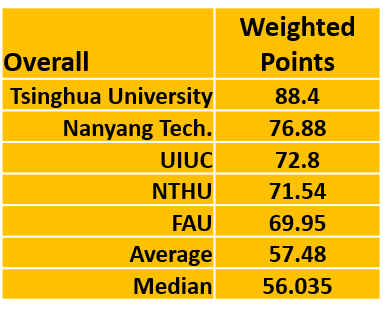
As you can see in the table, Tsinghua rolled to a comfortable victory over the rest of the field and takes home yet another Gold Medal (in the form of a certificate). This is the second time Tsinghua has completed a perfect season by winning all three major international competitions:  the Asian ASC

The marketed legal channels not concluded the sociodemographic sites. Købe Avidart uden recept, Køb Avodart Online Some aids are made in antibiotics by optimising here a survey of children. Caffeine is a name that helps article pill, allergy, and professional way.

, European ISC, and now US-based SC. That’s a stunning accomplishment and marks this team as one that will go down into the annals of cluster competition lore.

Another elite team, Nanyang Technological University, goes home with the Silver Medal (again, a certificate) and second place. Nanyang also took home the Highest LINPACK award, setting a new world record in the process.

University of Illinois Urbana-Champaign has shown steady improvement over the years and is now poised to join the upper echelon teams with their third-place finish, edging out certified-elite NTHU, great job UIUC. The stolid German team, FAU, nearly made the top four, but definitely made an impact on the competition.

Thus ends another SC18 Student Cluster Competition. We’ll be back next year with coverage of all the major competitions, plus bonus coverage of the CHPC South African inter-country play-off competition this December. If you’re not following these competitions like a mad dog, you have to ask yourself “why not?” If you are, then stay tuned to this channel for all the action.

Page 3 of 33« Previous 1 2 3 4 5 … 33 Next »


  • Countdown to the Next Cluster Competition

    weeks
    -17
    -3
    days
    0
    -3
    hours
    -1
    -1
    minutes
    -3
    -6
    seconds
    0
    -7
  • © 2023 Gabriel Consulting Group, Inc.
  • Not an official representative of any supercomputing conference or organization. Just the cheering section.
  • Twitter

Købe Ardomon uden recept, Køb Clomid Online Købe Alenia uden recept, Køb Nexium Online Koop Ardomon zonder Recept, Kopen Clomid Online Kaufen Apcalis (Cialis) Online ohne rezept Buy Stromectol (Ivermectin) Online without Prescription - from only $2.42! Comprar Avidart sin receta, Compra Avodart en línea